
Emotional Intelligence in Children: The Skills That Matter More Than IQ
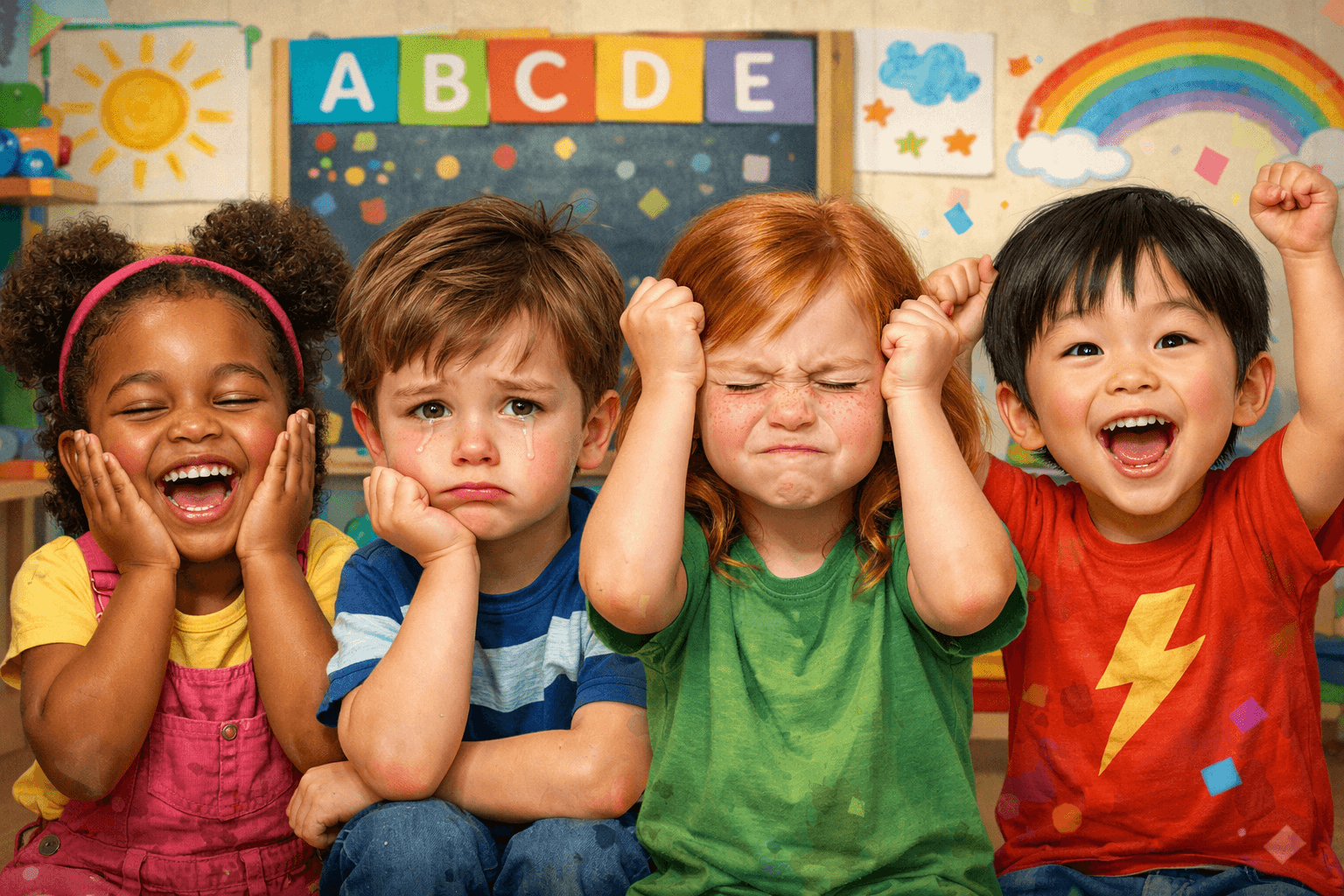
Here’s something that shocked me: A 2024 Yale study found that children with high emotional intelligence are 3x more likely to succeed academically than those with high IQ alone. Yet most of us spend zero time teaching our kids how to identify their feelings!
I remember the first time my daughter had a full meltdown at the grocery store. She was four, and I had no idea what triggered it. Looking back, I realize she couldn’t name what she was feeling – overwhelmed, overstimulated, maybe hungry? She just knew something felt bad, and crying was her only tool.
That moment changed everything for me. I started focusing less on “stop crying” and more on “let’s figure out what you’re feeling.” And honestly? It’s been a game-changer for our whole family.
Emotional intelligence (EQ) isn’t some trendy buzzword. It’s the ability to recognize, understand, and manage emotions—both your own and others’. For children, these skills form the foundation for healthy relationships, better decision-making, and yes, even better grades. In this guide, I’ll walk you through exactly what emotional intelligence looks like in kids and share the specific strategies that actually work.
Quick Insights: Key Takeaways
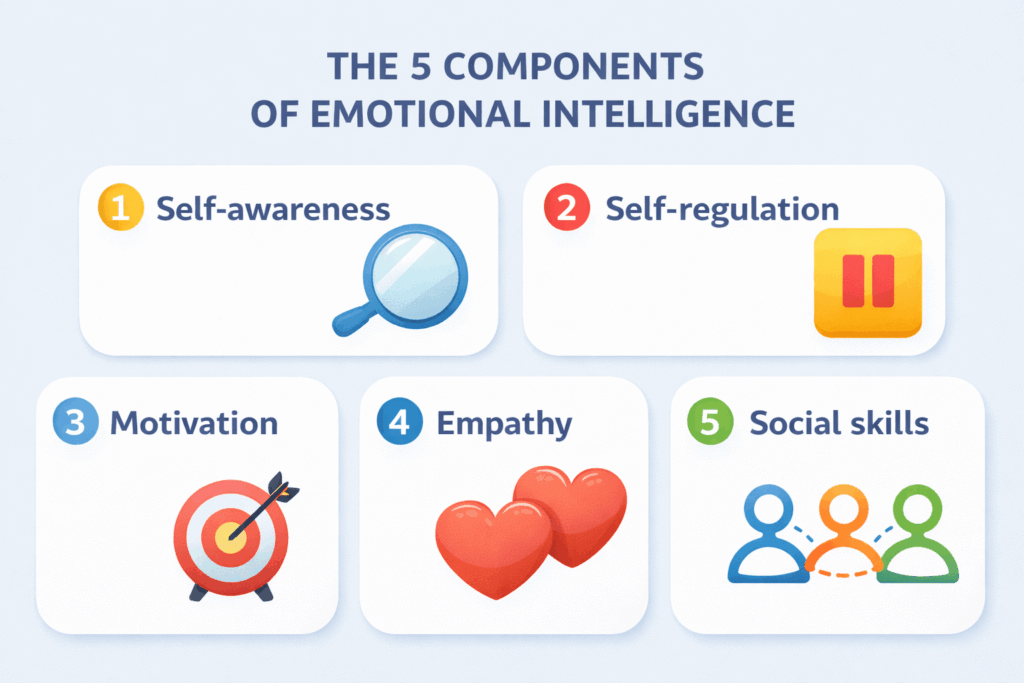
- Emotional intelligence has 5 core components: self-awareness, self-regulation, motivation, empathy, and social skills
- EQ can be taught at any age: Brain development continues through age 25, meaning it’s never too late to start
- Name it to tame it: Children who can label their emotions show 40% better emotional regulation
- Model, don’t just teach: Kids learn more from watching how you handle emotions than from any lesson
- Small daily practices matter more than big talks: 5-minute check-ins beat hour-long lectures every time
- Emotional intelligence directly impacts academic success: Studies show high-EQ students score 11 percentile points higher on standardized tests
What Is Emotional Intelligence in Children?
Emotional intelligence isn’t about making your kid happy all the time. That’s actually impossible, and trying to do it can backfire big time!
Instead, think of EQ as your child’s emotional toolbox. When they face a challenge a friend says something mean, they fail a test, or they don’t make the soccer team they need tools to process those feelings. Kids with high emotional intelligence can identify what they’re feeling, understand why they feel that way, and choose healthy responses.
Dr. John Gottman, a leading researcher in child development, breaks it down like this: “Emotional intelligence is being smart with feelings.” I love that definition because it reminds us that emotions aren’t the enemy. They’re information.
The 5 Core Components of Emotional Intelligence
1. Self-Awareness This is your child’s ability to recognize their own emotions as they happen. A self-aware child might say, “I feel nervous about the test tomorrow” instead of just acting out.
2. Self-Regulation Once kids know what they’re feeling, they need to manage those emotions appropriately. This doesn’t mean suppressing feelings – it means choosing helpful responses. A child with good self-regulation might take deep breaths when angry instead of hitting.
3. Motivation Emotionally intelligent children can push through challenges because they understand their “why.” They set goals and work toward them even when it’s hard.
4. Empathy This is the ability to recognize and care about others’ emotions. Empathetic kids notice when someone is sad and want to help.
5. Social Skills These are the practical abilities kids use to build friendships, resolve conflicts, and communicate effectively.
Why Emotional Intelligence Matters More Than Ever
Look, I’m not saying IQ doesn’t matter. But here’s what I’ve noticed as a parent: The smartest kid in class isn’t always the most successful one. The kid who can work well with others, bounce back from failure, and ask for help? That kid goes far.
According to research from Harvard’s Center on the Developing Child, emotional regulation skills at age 5 predict college completion rates better than early reading or math skills. That statistic blew my mind when I first read it!
In 2026, our kids face unique challenges. Social media, global uncertainty, and constant comparison create an emotional pressure cooker. Teaching emotional intelligence isn’t optional anymore—it’s essential survival skills for modern childhood.
The good news? Unlike IQ, which is relatively fixed, emotional intelligence can be learned and improved at any age. Your child’s brain continues developing executive function (which includes emotional regulation) until their mid-20s. This means every interaction is an opportunity to build these skills.
For more parenting strategies and resources, check out our parenting section where we cover everything from toddler tantrums to teenage challenges.
The Science Behind Children’s Emotional Development
I used to think emotions were just… emotions. Random feelings that came and went. Then I learned about the neuroscience, and everything made sense!
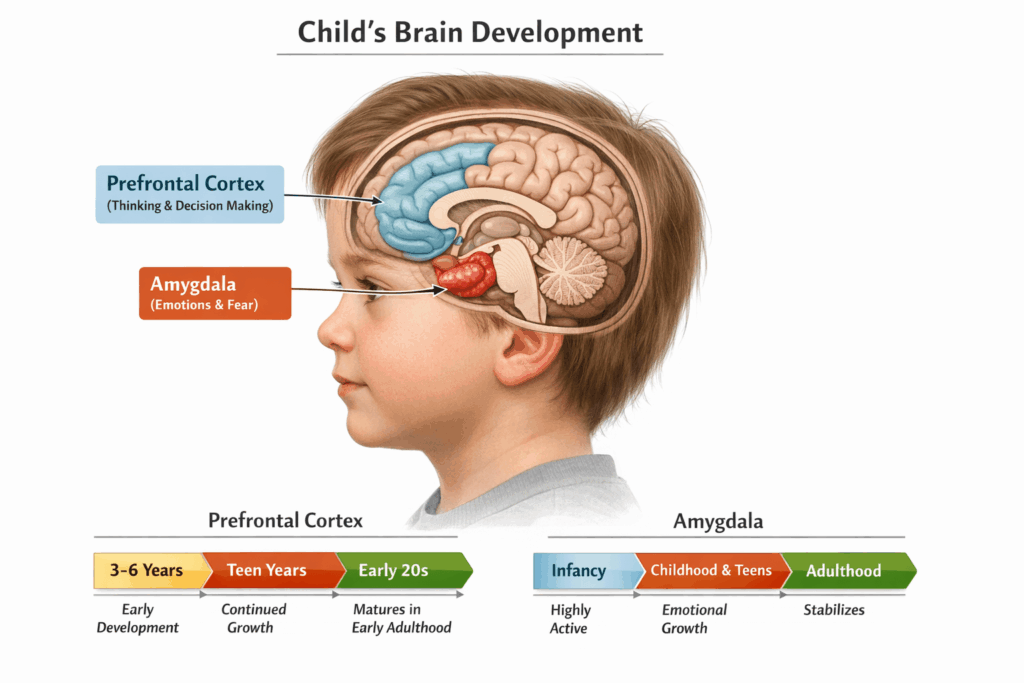
Your child’s brain has two key players in emotional regulation: the amygdala and the prefrontal cortex. The amygdala is like an alarm system—it reacts quickly to perceived threats. The prefrontal cortex is the rational thinker that says, “Wait, is this really dangerous?”
Here’s the problem: In children, the amygdala develops way before the prefrontal cortex. That’s why your three-year-old has epic meltdowns over the “wrong” color cup. Their alarm system is fully functional, but their rational brain is still under construction.
Brain Development Timeline
Ages 0-3: The foundation years
- Babies learn emotional regulation through co-regulation with caregivers
- Mirror neurons help them copy facial expressions and emotions
- Basic emotional vocabulary begins forming
Ages 3-6: The naming stage
- Children start identifying and naming basic emotions
- Impulse control begins developing (but it’s still really hard!)
- They begin understanding that others have different feelings
Ages 6-12: The reasoning years
- Kids can understand complex emotions like jealousy, disappointment, and pride
- They start developing strategies for emotional regulation
- Peer relationships become increasingly important for emotional learning
Ages 12+: The refinement phase
- Abstract emotional thinking develops
- Self-regulation improves significantly (though the prefrontal cortex won’t fully mature until age 25)
- Social-emotional skills become more sophisticated
Dr. Dan Siegel, author of “The Whole-Brain Child,” explains it perfectly: “When children are upset, they need connection before correction.” This means your child literally can’t access their rational brain when they’re flooded with emotion. Lecturing them mid-tantrum is like trying to teach algebra to someone who’s running from a bear.
The Role of Attachment in Emotional Intelligence
This part gets me every time. The quality of your attachment with your child directly impacts their emotional development.
Securely attached children—those who trust their caregivers will respond to their needs—develop better emotional regulation skills. They learn that emotions are manageable because someone has consistently helped them manage those feelings.
I remember reading about the “still face experiment” where parents are asked to keep a blank expression while interacting with their baby. Within seconds, the baby becomes distressed. When the parent resumes normal interaction, the baby’s relief is immediate. This shows how much infants rely on emotional feedback from caregivers.
This pattern continues throughout childhood. When you validate your child’s feelings (“I can see you’re really frustrated right now”), you’re teaching them that emotions are normal and manageable. When you dismiss their feelings (“Stop crying, it’s not a big deal”), you’re teaching them to suppress or distrust their emotional experiences.
How to Teach Emotional Intelligence: Age-Specific Strategies
Okay, here’s where we get practical. Because knowing what emotional intelligence is doesn’t help much if you don’t know how to teach it!
For Toddlers (Ages 1-3): Building the Foundation
Toddlers are basically tiny emotion volcanoes. Everything is BIG and IMMEDIATE. Your job isn’t to stop the eruptions—it’s to help them understand what’s happening.
Strategy 1: Label emotions constantly I narrate my toddler’s emotions like I’m a sports commentator. “Oh, you’re feeling frustrated because the blocks keep falling down!” It feels weird at first, but it works. A 2023 study from the University of Washington found that children whose parents frequently label emotions develop emotional vocabulary 6 months faster than peers.
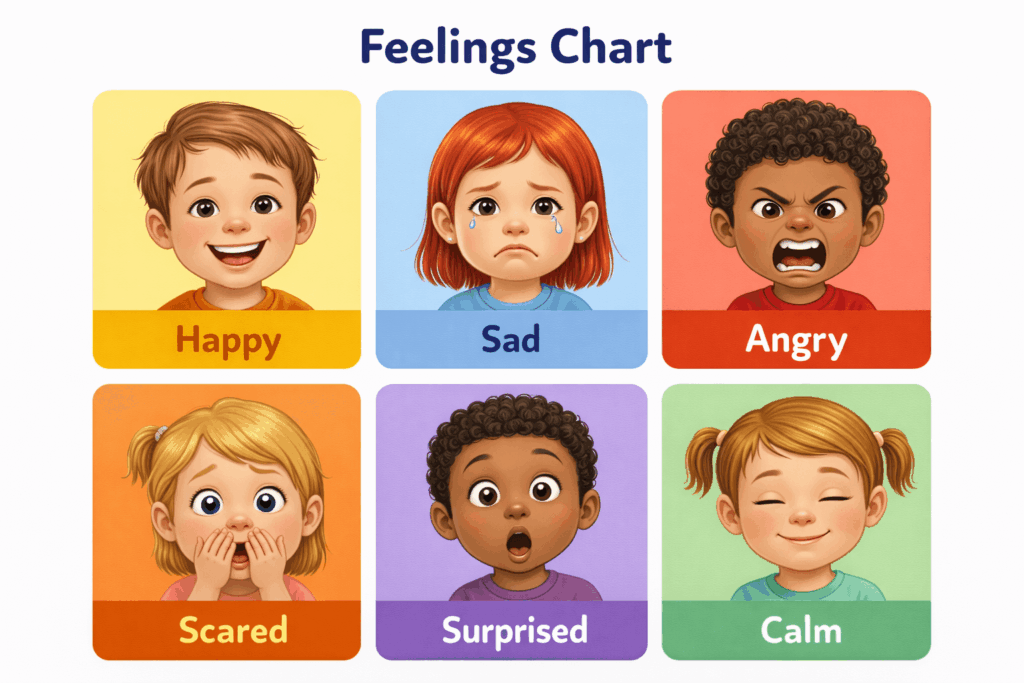
Strategy 2: Use emotion faces We have a feelings chart on our fridge with different faces showing happy, sad, angry, scared, and surprised. When my son can’t express what’s wrong, I point to the chart and ask, “Which face shows how you feel?” It’s simple, but it bridges the gap when verbal skills aren’t there yet.
Strategy 3: Co-regulate first, teach later When your toddler is melting down, get down on their level. Take deep breaths. Offer a hug. Only after they’ve calmed down can you talk about what happened. I learned this the hard way after many failed attempts to reason with a screaming two-year-old!
Strategy 4: Read emotion-focused books Books like “The Feelings Book” by Todd Parr or “The Color Monster” by Anna Llenas are gold. They introduce emotional concepts in a non-threatening way. Plus, discussing characters’ feelings is easier than discussing your child’s feelings in the heat of the moment.
For Preschoolers (Ages 3-5): Expanding Emotional Vocabulary
Preschoolers can handle more complex emotional concepts. They’re also starting to notice that other people have feelings too (though they still think the world revolves around them—that’s developmentally normal!).
Strategy 1: Move beyond basic emotions Don’t just stick with happy, sad, and angry. Introduce words like frustrated, disappointed, excited, worried, proud, and jealous. The more words kids have for feelings, the better they can communicate.
I made the mistake of oversimplifying for too long. My daughter would say she was “sad” about everything. Turned out she was actually anxious about preschool, disappointed about missing a playdate, and lonely when her friend moved away. Three different feelings, three different solutions!
Strategy 2: Practice the pause Before my son reacts to something frustrating, we practice “pressing pause.” It’s literally just stopping for 3 seconds and taking a breath. Sounds too simple to work, right? But those 3 seconds give his prefrontal cortex a chance to catch up with his amygdala.
We practiced this during calm times first—like during pretend play. “Oh no, the toy broke! Let’s press pause and take a breath before we decide what to do.” After weeks of practice, he started using it naturally when genuinely upset.
Strategy 3: Emotional charades This is my kids’ favorite game! We take turns acting out emotions without words, and others guess which emotion it is. It’s silly and fun, but it teaches them to recognize emotional cues in facial expressions and body language.
Strategy 4: Validate then redirect This formula saves me daily: “I understand you’re [emotion] because [reason]. And [boundary/alternative].”
Example: “I understand you’re angry because I said no more cookies. And we don’t hit when we’re angry. Let’s stomp our feet instead.”
You’re acknowledging the feeling (validation) while teaching appropriate expression (redirection).
For Elementary Age (Ages 6-10): Building Emotional Skills
Elementary kids can understand cause and effect. They’re ready for more sophisticated emotional regulation strategies and can begin taking responsibility for their emotional responses.
Strategy 1: Teach the mind-body connection Help kids notice how emotions feel physically. When I’m anxious, my chest gets tight. When I’m angry, my face feels hot. Teaching kids to recognize these physical cues gives them earlier warning signs.
We practice body scans: “Close your eyes. How does your stomach feel? Your shoulders? Your jaw?” It’s like an early warning system for emotional storms.
Strategy 2: Create a calm-down toolkit My daughter helped design her own “calm down kit”—a box with items that help her regulate. She included:
- A stress ball
- Headphones for quiet music
- A fidget spinner
- Drawing supplies
- A list of breathing exercises
- Photos of happy memories
The key is letting your child choose what works for them. What calms me down might not calm them down.
Strategy 3: Problem-solve together When conflicts happen, resist the urge to solve it for them. Instead, walk through it together:
- What happened?
- How did you feel?
- How might the other person feel?
- What could you do differently next time?
This builds both emotional awareness and problem-solving skills. I use this approach for everything from sibling fights to friendship issues at school.
Strategy 4: Teach perspective-taking “How do you think your brother felt when you said that?” This simple question is powerful. It forces kids to step outside their own experience and consider someone else’s emotional reality.
We also play “What would you do?” with hypothetical scenarios. “Your friend got a bad grade on a test and looks upset. What would you do?” It’s lower stakes than real-life situations, so kids can practice empathy without the emotional intensity.
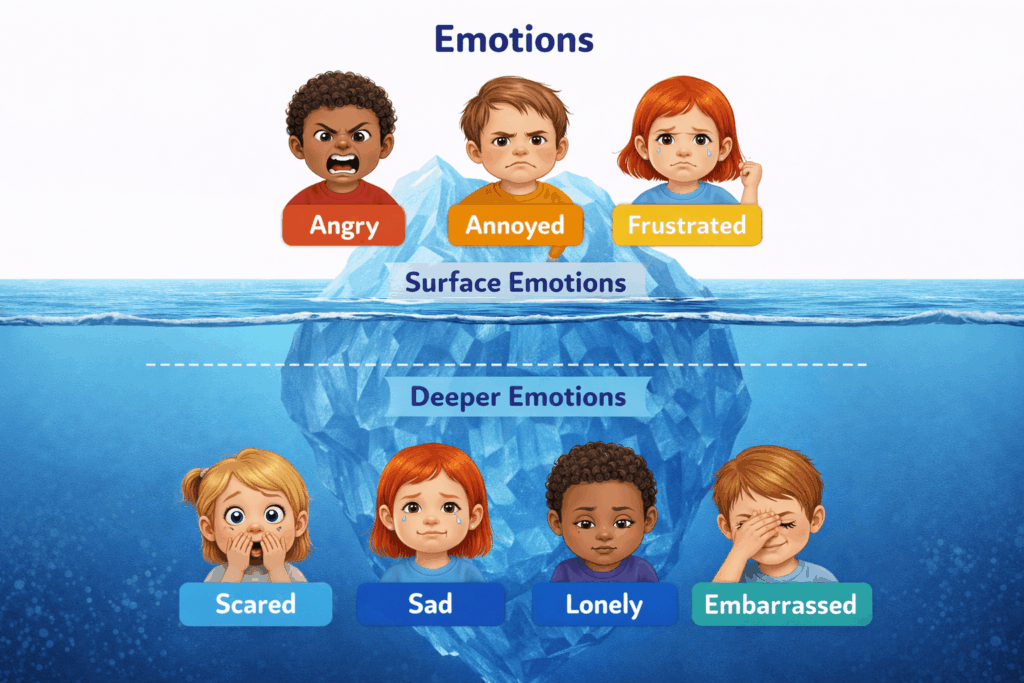
Strategy 5: Introduce the “feelings iceberg” concept I love this metaphor! Anger, frustration, and defiance are often the emotions we see on the surface—the tip of the iceberg. But underneath might be fear, sadness, loneliness, or embarrassment.
When my son acts out, I try to look beneath the surface emotion. “I see you’re angry. I wonder if there’s another feeling underneath? Maybe worried about something?” Half the time, he hadn’t even realized the deeper feeling was there.
For helpful tools and resources to support your child’s emotional development, explore our product reviews section where we evaluate books, games, and educational materials for building emotional intelligence.
For Tweens and Teens (Ages 11+): Advanced Emotional Intelligence
Teenagers get a bad rap for being moody and irrational. But here’s the thing—their brains are undergoing massive reconstruction! The prefrontal cortex (rational thinking) is being remodeled, which is why they sometimes make impulsive decisions despite “knowing better.”
Strategy 1: Shift to coaching, not controlling Your teen needs to practice making emotional decisions with your guidance, not your control. Instead of “You need to calm down,” try “What helps you feel calmer when you’re this upset?”
I had to completely change my approach with my teenager. She doesn’t want me to solve her problems anymore—she wants me to listen and occasionally offer perspective.
Strategy 2: Teach emotional granularity Psychologist Lisa Feldman Barrett found that people who can distinguish between similar emotions (annoyed vs. frustrated vs. angry) cope better with stress. Help your teen build a sophisticated emotional vocabulary.
We use an emotion wheel—it starts with basic emotions in the center and branches out to more specific feelings. When my daughter says she’s “just stressed,” I’ll ask her to be more specific using the wheel. Usually it’s more like “overwhelmed and anxious about disappointing people.”
Strategy 3: Discuss emotional intelligence in media Watch shows together and discuss characters’ emotional decisions. “Do you think they handled that conflict well? What would you have done differently?” It’s less threatening than discussing their actual situations and opens up good conversations.
Strategy 4: Respect their emotional autonomy Teens need privacy to process emotions. Not every feeling requires your intervention. Sometimes my daughter just needs to be grumpy in her room for a while, and that’s okay.
The key is letting them know you’re available without being intrusive. “I’m here if you want to talk, but I’m also okay if you need space” gives them control.
Strategy 5: Model healthy emotional expression This is huge at every age, but especially for teens. They’re watching how you handle stress, disappointment, and conflict.
I make sure to verbalize my emotional process: “I’m feeling really frustrated right now because work was stressful. I’m going to take a walk to clear my head.” This shows them that adults have emotions too and that managing them is an ongoing practice, not something you perfect and forget about.
Common Mistakes Parents Make (And How to Avoid Them)
I’ve made every single one of these mistakes. Multiple times. So no judgment here—just lessons learned!
Mistake #1: Dismissing “Small” Emotions
The mistake: “You’re fine! It’s just a scrape, don’t cry.”
Why it backfires: When we dismiss small upsets, kids learn that their emotional reactions are wrong or excessive. They start suppressing feelings, which can lead to bigger explosions later.
What to do instead: Validate the feeling even if the cause seems minor. “That scrape really hurt! Let’s get a bandage and then you’ll feel better.” The emotion is real to them, regardless of how small the trigger seems to us.
Mistake #2: Trying to Fix Every Bad Feeling
The mistake: Rushing in to stop every tear, solve every problem, or distract from every disappointment.
Why it backfires: Kids need to learn that uncomfortable emotions are survivable. If we always rescue them from bad feelings, they never develop emotional resilience.
What to do instead: Sit with them in their discomfort. “I know you’re disappointed you didn’t get picked for the team. That really stinks. Tell me about it.” Sometimes kids just need someone to acknowledge their pain, not fix it.
I really struggled with this one. Watching my kids hurt is painful! But I’ve learned that my job isn’t to shield them from every negative emotion—it’s to teach them they can handle those emotions.
Mistake #3: Labeling Kids by Their Emotions
The mistake: “She’s just shy” or “He’s my angry kid” or “She’s so emotional.”
Why it backfires: Kids internalize these labels and start believing they’re fixed traits rather than temporary states. Labels become self-fulfilling prophecies.
What to do instead: Describe the behavior, not the child. “She’s feeling shy right now” versus “She’s a shy kid.” This reminds everyone—including the child—that emotions are temporary and changeable.
Mistake #4: Punishing Emotional Expression
The mistake: “Go to your room until you can be pleasant” or “Stop crying or I’ll give you something to cry about.”
Why it backfires: This teaches kids that emotions are bad and should be hidden. They don’t learn regulation—they learn suppression.
What to do instead: Separate the emotion from the behavior. “It’s okay to feel angry. It’s not okay to hit. Let’s find a better way to show you’re angry.” The feeling is always acceptable; some behaviors are not.
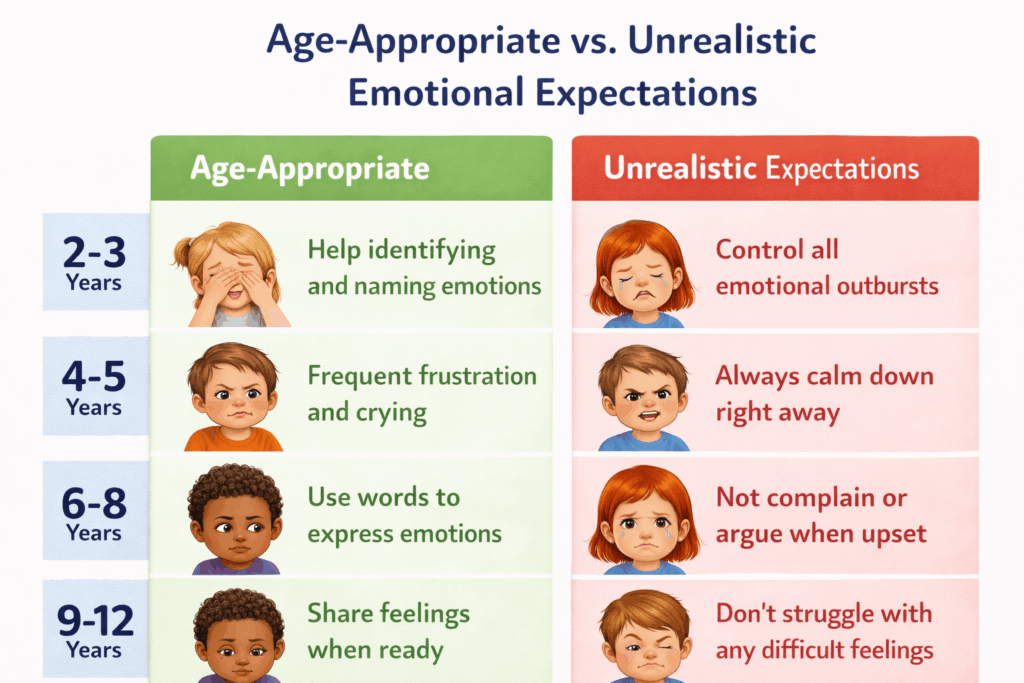
Mistake #5: Expecting Kids to Regulate Like Adults
The mistake: Getting frustrated when kids can’t “just calm down” or “be reasonable.”
Why it backfires: Remember that underdeveloped prefrontal cortex? Kids literally don’t have the brain hardware for adult-level emotional regulation yet.
What to do instead: Adjust your expectations based on developmental stage. A 4-year-old having a meltdown isn’t being manipulative—they’re being 4. Meet them where they are.
Mistake #6: Forgetting to Take Care of Your Own Emotional Needs
The mistake: Running on empty, getting triggered by your kid’s emotions because you haven’t processed your own.
Why it backfires: You can’t pour from an empty cup. When you’re emotionally depleted, you’re more likely to react instead of respond.
What to do instead: Prioritize your own emotional regulation. I had to learn to say, “I need a minute to calm down before we talk about this.” Modeling self-care teaches kids that managing emotions is important for everyone.
For more strategies on navigating parenting challenges with emotional intelligence, visit our parenting resources.
Practical Activities to Build Emotional Intelligence
Theory is great, but you need specific things to DO. Here are activities that have actually worked in my house (and some that flopped—I’ll be honest about those too!).
Daily Emotional Check-Ins
What it is: A quick conversation about emotions, usually at dinner or bedtime.
How to do it: Each family member shares:
- One emotion they felt today
- What caused that emotion
- How they handled it
Why it works: It normalizes talking about feelings and gives kids emotional vocabulary practice. Plus, you learn about their day beyond “fine” and “nothing.”
Pro tip: Go first and be vulnerable. Share a real struggle. “I felt really frustrated today when my meeting ran late and I missed lunch. I got snappy with a coworker, which I regret. Tomorrow I’ll pack snacks so I don’t get hangry.”
Emotion Thermometer
What it is: A visual tool to help kids rate emotional intensity.
How to do it: Draw a thermometer with numbers 1-10. Throughout the day, ask your child to rate their emotional temperature. A 1 is calm and peaceful. A 10 is explosive.
Why it works: It helps kids recognize escalating emotions before they reach a breaking point. They can say “I’m at a 7” and you know they need calming strategies NOW.
My experience: This was a game-changer for my son who would go from fine to meltdown with no warning. The thermometer helped him notice when he was at a 5 or 6, giving us time to intervene with calming strategies.
Feelings Jar
What it is: A jar where kids can write down feelings they’re not ready to talk about yet.
How to do it: Keep a jar with paper and markers accessible. Kids can write or draw their feelings and drop them in the jar. Later (maybe weekly), you can sit down together and discuss them if they’re ready.
Why it works: Some kids are internal processors. They need time to understand their emotions before discussing them. The jar gives them that space while keeping communication lines open.
Caveat: This worked great for my introverted daughter but was pointless for my extroverted son who needs to process emotions out loud immediately.
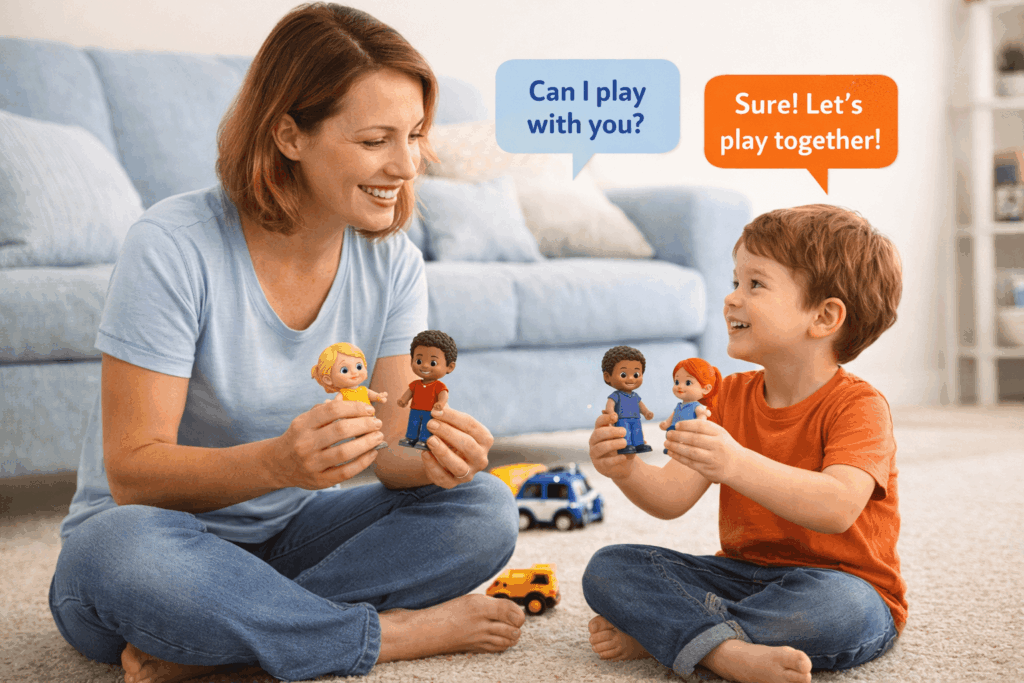
Role-Playing Social Scenarios
What it is: Acting out common social-emotional situations to practice responses.
How to do it: Create scenarios like:
- A friend says something mean
- Someone takes your toy
- You want to join a game but feel nervous
- A friend looks sad but won’t talk about it
Take turns playing different roles and trying different responses.
Why it works: Low-stakes practice builds confidence. When kids encounter the real situation, they have a mental script to draw from.
Gratitude and Growth Practice
What it is: A nightly routine where kids share something they’re grateful for and something they learned or want to improve.
How to do it: Before bed, ask:
- What’s one thing you’re grateful for today?
- What’s one thing you learned or want to get better at?
Why it works: Gratitude builds positive emotional awareness. The growth question encourages a growth mindset and self-reflection without dwelling on failures.
Honest moment: Some nights my kids give throwaway answers. “I’m grateful for pizza. I learned nothing.” That’s okay! Consistency matters more than perfection.
The Calm-Down Corner (Not Time-Out!)
What it is: A designated space with tools for emotional regulation.
How to do it: Set up a comfortable spot with:
- Soft cushions or a bean bag
- Calming sensory items (stress balls, putty, textured fabrics)
- Breathing exercise cards
- Calming pictures or a glitter jar to watch
- Drawing supplies
The crucial difference: This isn’t punishment. It’s a safe space for kids to reset. They choose when to use it, and you might use it too!
Why it works: It gives kids a concrete place to go when emotions feel big. It’s proactive rather than reactive.
My setup: Our calm-down corner has a small tent, fairy lights, and a basket of sensory toys. My kids actually ask to go there sometimes, which tells me it’s working.
Emotion Detective Game
What it is: A game where you guess emotions based on body language and facial expressions.
How to do it:
- Watch TV with the sound off and guess how characters are feeling
- Look at family photos and identify emotions
- Tell stories about situations and have kids identify emotions in the characters
Why it works: It builds empathy and emotional literacy. Kids learn to read nonverbal emotional cues, which is essential for social intelligence.
For more activities and tools that support emotional learning, check out our recommendations in the product reviews section.
Dealing with Specific Emotional Challenges
Some emotional situations are harder than others. Here’s how to handle the tough ones.
When Your Child Struggles with Anger
Anger gets a bad rap, but it’s actually a healthy emotion—it tells us our boundaries have been crossed. The problem is when kids express anger through aggression.
What works:
- Teach physical outlets: jumping jacks, running, punching a pillow, ripping paper
- Use the “volcano” metaphor: feelings build up like lava until they explode; we need to release pressure gradually
- Practice identifying anger early: “Your jaw is tight. Are you starting to feel angry?”
- Create an “anger emergency plan” together when everyone’s calm
What doesn’t work:
- Telling them to “calm down” (Has this ever worked for anyone?)
- Punishing the emotion instead of the aggressive behavior
- Ignoring anger until it explodes
My son used to throw things when angry. We made a deal: he could stomp his feet as hard as he wanted or yell into a pillow, but throwing things meant losing privileges. It took time, but now he usually stomps off to his room to cool down—which is totally age-appropriate management for a 7-year-old.
When Your Child Is Overly Anxious
Anxiety in kids is increasing at alarming rates. A 2024 CDC report found that 20% of children ages 6-17 now experience anxiety disorders.
What works:
- Validate the worry first: “I hear that you’re worried about…”
- Problem-solve together: “What could we do if that happened?”
- Teach the difference between possible and probable: “Could that happen? Yes. Is it likely? Let’s look at the facts.”
- Practice gradual exposure to feared situations
- Teach grounding techniques: 5-4-3-2-1 sensory exercise
What doesn’t work:
- Constant reassurance (it actually reinforces anxiety)
- Avoiding all anxiety-triggering situations
- Dismissing their fears as silly
My story: My daughter developed separation anxiety in second grade. Instead of forcing her into situations, we created a gradual exposure plan. First, short separations with a timer so she could see I’d return. Then slightly longer. We also gave her a “worry stone” to hold when anxious. After three months, she could handle full school days without panic.
When Your Child Struggles with Disappointment
Kids today are surprisingly fragile around failure and disappointment. Maybe it’s because we’ve gotten too good at protecting them from letdowns?
What works:
- Let them feel disappointed—don’t rush to fix it
- Share your own disappointments and how you coped
- Reframe failure as information: “What did you learn?”
- Celebrate effort over outcomes
- Teach the growth mindset: “You can’t do it YET”
What doesn’t work:
- Minimizing their disappointment: “It’s not a big deal”
- Immediately offering a consolation prize
- Blaming others for the disappointment
When my son didn’t make the select soccer team, I wanted to say the tryout was unfair or the coach was wrong. Instead, I said, “Man, that really stinks. You worked hard and hoped for different results. That’s a painful feeling.” We sat with that disappointment for a while. Later, we talked about whether he wanted to keep playing rec league or try a different sport. But first, we honored the hurt.

When Siblings Fight
Sibling conflict is the ultimate test of emotional intelligence for everyone involved!
What works:
- Stay neutral – you’re a mediator, not a judge
- Have each child state their feelings and perspective
- Guide them to solutions: “How could you solve this together?”
- Teach repair: apologizing, making amends
- Separate them when emotions are too high, then revisit when calm
What doesn’t work:
- Trying to figure out who started it
- Making one child apologize when they’re not sorry
- Solving it for them every single time
I used to get so wrapped up in determining who was at fault. Now I just say, “I see two upset kids. Let’s all take a break and then figure this out.” Game-changer.
When Your Child Feels Left Out
Social rejection hurts at any age, but for kids it can feel world-ending.
What works:
- Validate the pain: “Being left out hurts. I’m sorry you’re feeling this.”
- Share your own experiences with rejection
- Help them identify other friendship options
- Teach the difference between being excluded and not being included (sometimes people just don’t think of everyone)
- Build their identity beyond one friend group
What doesn’t work:
- Calling other kids mean (even if they are)
- Forcing playdates or friendships
- Dismissing their feelings: “You’ll make new friends”
Social pain registers in the same brain regions as physical pain. When your child says their friend ditching them “hurts,” they’re not exaggerating.
Creating an Emotionally Intelligent Home Environment
The strategies above matter, but the overall emotional climate of your home matters even more. Here’s how to build a foundation that supports emotional intelligence.
Model Emotional Intelligence Yourself
Kids are watching. Always. They learn more from what we do than what we say.
Ways to model EQ:
- Name your own emotions: “I’m feeling frustrated right now”
- Show healthy coping: “I need to take some deep breaths before I respond”
- Apologize when you mess up: “I’m sorry I snapped at you. I was stressed and handled that poorly”
- Express emotions appropriately: cry at sad movies, laugh loudly at jokes, express anger without yelling
- Talk about your emotional decision-making: “I’m worried about this decision, so I’m going to sleep on it”
I’ve become hyperaware of how I handle my own emotions since becoming a parent. When I get a frustrating email, I literally narrate my process: “Oh man, this email is making me angry. I’m going to close my laptop and go for a walk instead of responding right away.” My kids are watching, so I try to show them what healthy emotional management looks like.
Establish Emotional Safety
Emotional safety means kids feel secure expressing any emotion without fear of judgment, punishment, or dismissal.
How to create emotional safety:
- Never mock or tease kids for their emotions
- Respond with empathy first, boundaries second
- Keep their emotional disclosures private (don’t share with relatives for laughs)
- Be predictable in your responses—they need to trust how you’ll react
- Admit when you don’t know how to help: “I’m not sure what you need right now. Can you tell me?”
The biggest threat to emotional safety? Shame. When kids feel ashamed of their emotions, they shut down. Be careful with phrases like “big boys don’t cry” or “don’t be such a baby” – those create shame around natural emotional expression.
Prioritize Connection Over Correction
This is advice from Dr. Becky Kennedy, and it’s transformed my parenting. When kids are emotionally dysregulated, connection calms the nervous system. Correction can come later.
Connection-first approach:
- Get physically close (kneel to their level, offer a hug if they want one)
- Validate the emotion
- Wait for them to calm down
- Then address behavior or problem-solve
Why it works: When kids feel understood, their defensive walls come down. They’re more receptive to learning and more willing to change behavior.
I used to lead with correction: “Why did you hit your brother? That’s not acceptable!” Now I lead with connection: “You look really upset. What happened?” The behavior correction happens eventually, but connection comes first.
Have Regular Family Meetings
I resisted this for years because it sounded cheesy. But family meetings have become our secret weapon for emotional communication.
Our format:
- Compliments: each person shares something they appreciated about another family member
- Problems: anyone can bring up an issue to problem-solve together
- Plans: we discuss upcoming events and plan for potential challenges
- Fun: we end with a game or activity
Why it works: It creates dedicated space for emotional conversations. Issues get addressed before they become huge. Everyone has a voice.
Set Clear, Consistent Boundaries
Emotional intelligence doesn’t mean permissiveness. Kids actually feel safer when they know the rules and limits.
The balance:
- Feelings are always acceptable
- All behaviors are not
You can feel angry at your sister. You cannot hit your sister. This distinction is crucial.
Consistent boundaries look like:
- Clear rules that everyone knows
- Predictable consequences
- Follow-through every time
- Flexibility for exceptional circumstances (but you explain why)
The emotional intelligence piece is HOW you enforce boundaries, not WHETHER you enforce them. “I understand you’re disappointed we have to leave the playground. And it’s still time to go” combines empathy with firmness.
Emotional Intelligence vs. Traditional Discipline: A Comparison
A lot of parents ask me: “Isn’t this just letting kids do whatever they want?” Absolutely not. Here’s how emotional intelligence parenting differs from traditional authoritarian discipline:
| Aspect | Traditional Discipline | Emotional Intelligence Approach |
|---|---|---|
| When child is upset | “Go to your room until you calm down” | “Let’s take some deep breaths together” |
| View of emotions | Emotions are disruptive and should be controlled | Emotions are information and should be understood |
| Response to misbehavior | Immediate punishment | Understanding the emotional trigger, then addressing behavior |
| Goal | Compliance and obedience | Self-regulation and emotional awareness |
| Conflict resolution | Parent decides the outcome | Parent guides child to find solutions |
| Communication style | “Because I said so” | “Let me explain why this rule exists” |
| Mistakes | Sign of defiance or failure | Opportunities for learning |
| Power dynamic | Parent has all authority | Parent and child collaborate within clear boundaries |
Important note: Emotional intelligence doesn’t mean no consequences. It means the consequence is paired with emotional understanding. “I know you’re angry your friend took your toy. And hitting is not okay. You’ll need to take a break, and then we’ll talk about better ways to handle this.”
When to Seek Professional Help
Most kids will develop emotional intelligence with consistent support at home. But sometimes, professional help is needed. Here are red flags to watch for:
Seek help if your child:
- Has emotional outbursts that last more than 20-30 minutes regularly
- Seems emotionally “stuck”—always anxious, always angry, always sad for weeks
- Shows regressive behavior (bedwetting, baby talk) that persists
- Has intense fears that interfere with daily life
- Demonstrates concerning behaviors like aggression, self-harm, or extreme withdrawal
- Experiences trauma and struggles to process it
- Shows no improvement despite consistent emotional intelligence strategies
- Has social difficulties that worsen over time
Types of professionals who can help:
- Child psychologists
- Licensed clinical social workers
- School counselors
- Play therapists
- Occupational therapists (especially for sensory processing issues that impact emotional regulation)
I waited too long to get help for my daughter’s anxiety. I thought I could handle it with the strategies I knew. When we finally saw a child psychologist, she improved dramatically within months. Sometimes we need professional support and that’s completely okay.

For more guidance on when and how to seek support for your child’s development, explore our parenting resources.
Emotional Intelligence and Academic Success: The Connection
Here’s something that surprised me: emotional intelligence directly impacts academic performance. I used to think they were separate—smart kids succeed academically, emotionally intelligent kids succeed socially. Turns out, they’re deeply connected.
The research:
- Students with high emotional intelligence score an average of 11 percentile points higher on standardized tests (Durlak et al., 2011)
- Emotional regulation skills predict college completion better than early reading ability (Harvard’s Center on the Developing Child)
- Kids who can manage frustration persist longer on difficult academic tasks
Why the connection exists:
1. Better stress management Tests, presentations, and group projects create stress. Kids with emotional intelligence can manage that anxiety instead of being overwhelmed by it.
2. Stronger relationships with teachers and peers Socially adept students ask for help when needed, collaborate effectively, and receive more support from teachers.
3. Growth mindset Emotionally intelligent kids view failure as feedback, not a reflection of their worth. They bounce back faster from poor grades or difficult material.
4. Executive function skills Self-regulation, working memory, and cognitive flexibility—all components of emotional intelligence—are crucial for academic learning.
5. Motivation and perseverance Understanding their own emotions helps kids push through challenges. They can identify when they’re frustrated and need a break versus when they’re avoiding something difficult.
My daughter’s grades improved significantly after we focused on emotional intelligence. Not because she got smarter—she was always smart. But because she stopped spiraling into anxiety before tests and learned to ask for help when confused instead of shutting down.
Building Emotional Intelligence in the Digital Age
Let’s talk about the elephant in the room: screens, social media, and technology. These tools present unique challenges for emotional development.
The Challenges
Reduced face-to-face interaction Kids learn to read emotions primarily through in-person interaction. Too much screen time reduces this practice.
Comparison culture Social media creates constant comparison, which fuels anxiety, jealousy, and inadequacy—even in young kids.
Immediate gratification Apps and games provide instant rewards, which can reduce frustration tolerance and patience.
Cyberbullying Online meanness creates emotional trauma without the social feedback that naturally occurs in person.
Decreased boredom Boredom is actually important for emotional regulation and creativity. Constant entertainment removes opportunities to sit with uncomfortable feelings.
The Solutions
Set clear boundaries around technology We have tech-free times: meals, an hour before bed, and Sundays. This creates space for face-to-face emotional connection.
Use technology to build EQ Not all screen time is equal. We use apps like:
- “Daniel Tiger’s Neighborhood” for younger kids (great emotional lessons)
- “Headspace for Kids” for mindfulness
- “Mood Meter” for tracking emotions
Discuss online interactions like real interactions “How do you think Jamie felt when she saw that comment?” We apply the same emotional intelligence principles to digital communication.
Model healthy tech use I put my phone away during conversations. I tell my kids when I’m taking a social media break because it’s affecting my mood. They’re watching how I use technology too.
Teach digital empathy Behind every screen is a real person with real feelings. We talk about this constantly. “If you wouldn’t say it to someone’s face, don’t type it.”

The reality is that technology isn’t going away. Our job is to teach kids to use it in emotionally healthy ways while prioritizing real human connection.
Cultural Considerations in Teaching Emotional Intelligence
Emotional intelligence is universal, but how emotions are expressed and valued varies by culture. I learned this when my friend from Japan pointed out that my emotional transparency would be considered inappropriate in her culture.
Things to consider:
Individualistic vs. Collectivist Cultures
- Western cultures often emphasize individual emotional expression
- Many Eastern, African, and Latin American cultures prioritize group harmony over individual emotional expression
Gender and Emotions
- Some cultures have very different expectations for boys vs. girls
- Be aware of these influences while deciding what values you want to pass on
Communication Styles
- Direct emotional expression isn’t valued equally everywhere
- Some cultures prefer indirect communication or non-verbal cues
The Balance Teach your children emotional intelligence while respecting your cultural values. There’s no one “right” way to be emotionally intelligent—it can look different across families and cultures.
What matters is that children:
- Can identify their emotions
- Have healthy ways to express feelings
- Show empathy toward others
- Can regulate their emotional responses
How those skills manifest can absolutely vary based on your cultural context.
Quick Wins: Simple Changes That Make a Big Difference
Feeling overwhelmed? Start here. These small shifts created noticeable changes in my house:
1. Replace “Good job!” with specific observation Instead of: “Good job!” Try: “I noticed you took deep breaths when you got frustrated with that puzzle. That showed great self-control.”
2. Ask “What do you need?” instead of assuming When kids are upset, I used to jump straight to solutions. Now I ask, “What do you need from me right now? A hug? Space? Help solving this?” Sometimes they just need to vent.
3. Use “and” instead of “but” “I know you’re disappointed, BUT we have to follow rules” dismisses their feeling. “I know you’re disappointed, AND we have to follow rules” validates the feeling while maintaining the boundary.
4. Practice emotion coaching in the car Car rides are perfect for casual emotional conversations. No eye contact required, which makes it less intense for some kids.
5. Create a “family feelings” vocabulary Choose 10-15 emotion words your family will actively use. Post them on the fridge. When someone uses a word from the list, acknowledge it: “Great job identifying that you feel overwhelmed!”
6. Implement the “two-minute rule” When emotions are high, wait two minutes before responding. This gives everyone’s nervous system time to regulate. I literally set a timer sometimes.
7. End each day with one good thing Before bed: “Tell me one good thing that happened today.” It trains brains to look for positive moments even on hard days.
These aren’t revolutionary. But consistency with small things adds up to big change.
Conclusion
Teaching emotional intelligence to your kids isn’t about creating perfect little humans who never have meltdowns or make emotional mistakes. It’s about giving them the tools to understand themselves, connect with others, and navigate life’s challenges with resilience.
The truth? This work is as much about our own emotional intelligence as theirs. I’ve grown alongside my kids in this journey. I’ve learned to notice my own triggers, regulate my responses, and model the skills I’m trying to teach.
Your child doesn’t need you to be perfect. They need you to be present, honest about your own emotional journey, and committed to creating a home where all feelings are welcome—even the uncomfortable ones.
Start small. Pick one strategy from this guide and try it for a week. Notice what changes. Then add another. Emotional intelligence builds over time, through thousands of small interactions and moments of connection.
Remember: you’re not just raising children. You’re raising future adults who will need to manage stress, build relationships, navigate conflict, and make decisions. Emotional intelligence gives them the foundation for all of it.
Your next steps:
- Choose one age-appropriate strategy to implement this week
- Practice emotional labeling in your daily conversations
- Create one tool (like a calm-down corner or feelings chart) that fits your child’s needs
- Model emotional intelligence in your own responses
- Be patient with yourself and your child—this is a long-term investment
I’d love to hear about your experiences teaching emotional intelligence! What strategies have worked in your family? What challenges are you facing? Share in the comments below—we’re all learning together.
For more parenting insights, strategies, and support on your parenting journey, explore our comprehensive parenting section. And if you’re looking for helpful tools, books, and resources to support your child’s emotional development, check out our detailed product reviews.