Travel Bucket List Ideas Before You Turn 40

Your 30s hit different when it comes to travel. You finally have more money than your 22-year-old self, more clarity about what you actually want, and just enough urgency to stop putting things off. If you’ve been mentally building a travel bucket list ideas before 40 but haven’t pulled the trigger, this is your sign.
This guide is for people in their 30s who want to travel bigger, smarter, and more intentionally — not just collect passport stamps, but actually feel something along the way.
If your bucket list feels expensive, start with my comprehensive budget travel guide to learn how to visit more destinations without overspending.
Here’s what we’ll cover:
- Natural wonders and adventure travel ideas that belong on every serious bucket list
- Life-changing cultural travel experiences that completely shift how you see the world
- Affordable bucket list travel tips so money stops being the excuse that keeps you home
No fluff, no vague inspiration. Just real destinations, honest advice, and a push to finally book the trip you keep talking about.
Why Your 30s Are the Perfect Time to Travel Big
You Have More Financial Freedom Than in Your 30s
Your 20s were mostly about figuring things out — juggling entry-level salaries, student loans, and the occasional ramen dinner. By the time your 30s roll around, the financial picture usually looks a lot different. You’ve had years to build your career, grow your income, and actually save money with intention.
That shift matters enormously when it comes to crossing off bucket list trips before 40. You’re no longer limited to the cheapest hostel beds or red-eye flights with three layovers just to save $80. You can afford to do things properly — upgrade to a private tour in Machu Picchu, stay in an overwater bungalow in the Maldives, or book a guided safari in Kenya without emptying your entire savings account.
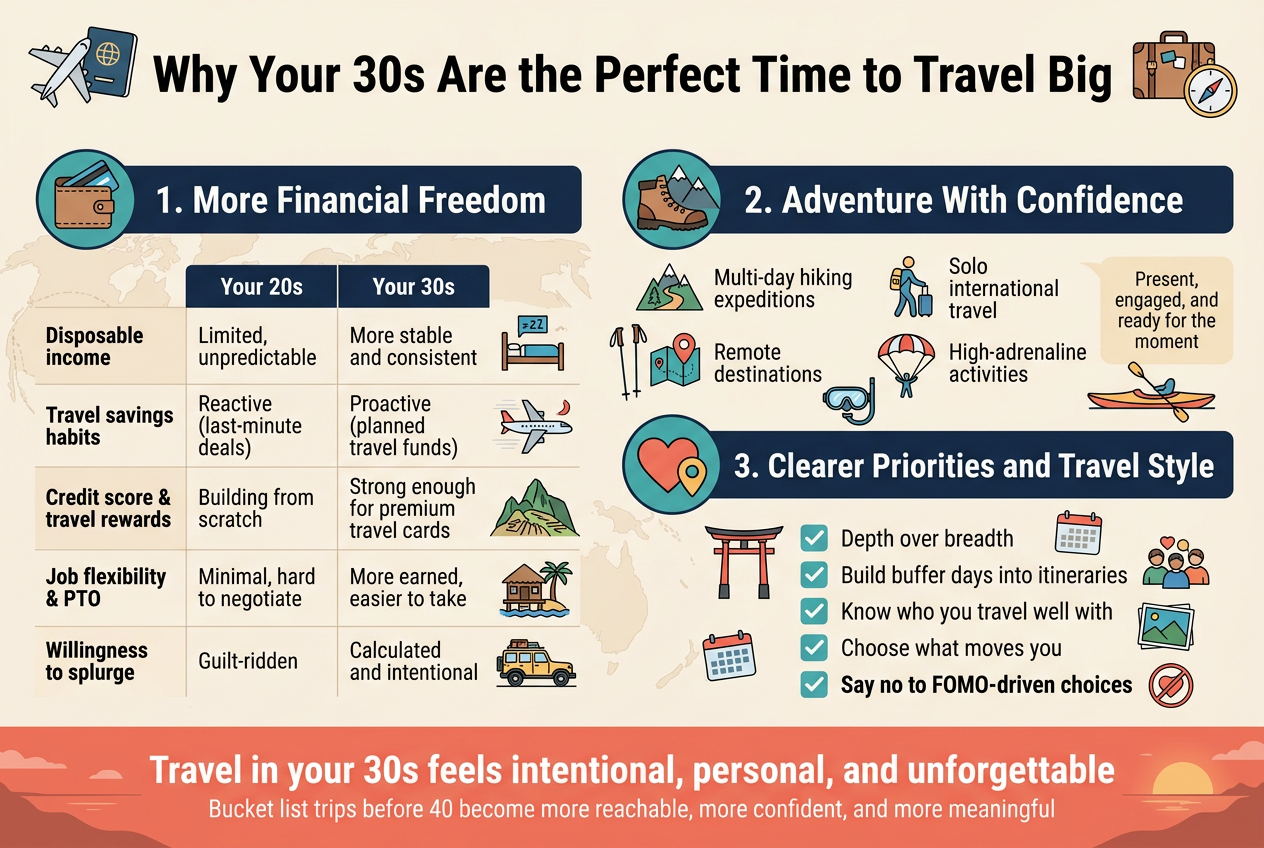
Here’s what typically changes financially between your 20s and 30s:
| Financial Factor | Your 20s | Your 30s |
|---|---|---|
| Disposable income | Limited, unpredictable | More stable and consistent |
| Travel savings habits | Reactive (last-minute deals) | Proactive (planned travel funds) |
| Credit score & travel rewards | Building from scratch | Strong enough for premium travel cards |
| Job flexibility & PTO | Minimal, hard to negotiate | More earned, easier to take |
| Willingness to splurge | Guilt-ridden | Calculated and intentional |
This doesn’t mean you need to be wealthy to travel well in your 30s. It means you’ve built enough of a foundation to make affordable bucket list travel feel genuinely within reach. You can research smarter, budget with purpose, and make trade-offs that actually align with what you want from a trip — not just what you can barely afford.
You Can Handle Adventure With Confidence and Experience
There’s a real difference between being brave and being prepared. In your 20s, adventure travel often meant winging it — showing up somewhere with a backpack and a vague plan, hoping everything would work out. Sometimes it did. Sometimes it absolutely didn’t.
By your 30s, you’ve accumulated enough travel experience (and a few cautionary tales) to approach adventure travel ideas with both excitement and smart preparation. You know how to research visa requirements before you land, how to pack light without sacrificing comfort, and how to spot a sketchy situation before it becomes a problem.
That confidence changes everything about how you experience a destination. When you’re trekking through Patagonia or white-water rafting in Costa Rica, you’re not spending half your mental energy on logistics anxiety. You’re actually there — present, engaged, and getting the most out of every moment.
Some adventures you’re now far better equipped to handle in your 30s:
- Multi-day hiking expeditions like the Inca Trail or Everest Base Camp — you have the physical fitness awareness and the gear knowledge to do it right
- Solo international travel — you’ve built the confidence to navigate foreign cities, communicate across language barriers, and trust your instincts
- Remote or off-the-beaten-path destinations — you’re not rattled by uncertainty the way you might have been at 22
- High-adrenaline activities like skydiving, scuba diving in open ocean, or bungee jumping — you can properly assess risk and choose experiences that suit your comfort level
Your body is also still very much on your side in your 30s. You have the energy and physical capability to tackle demanding bucket list trips — whether that’s a week-long cycling tour through Vietnam or a multi-day kayaking adventure in New Zealand. That’s a window worth taking full advantage of.
Your Priorities and Travel Style Are Clearer Than Ever
One of the most underrated parts of how to travel in your 30s is simply knowing yourself better. You’ve had enough trips — good ones, disappointing ones, and downright exhausting ones — to understand what you actually want from travel.
In your 20s, there was enormous pressure to travel a certain way. Stay in party hostels. Follow the well-worn backpacker trail. Cram twelve countries into three weeks because more always felt like better. By your 30s, you’ve shed most of that noise. You know whether you’re the kind of traveler who wants to slow down and really live in a city for two weeks, or someone who thrives on a packed itinerary with new destinations every few days.
That self-knowledge makes every trip more meaningful. Instead of booking something because it looks good on social media or because everyone else is doing it, you’re choosing life-changing travel destinations that genuinely speak to you.
Here’s what clearer priorities might look like in practice:
- You value depth over breadth — spending 10 days in Japan exploring local neighborhoods and hidden temples rather than a rushed 10-country Euro trip
- You’ve identified your travel triggers — maybe you hate rushing through airports, so you always build buffer days into your itinerary
- You know your travel companions — you’ve figured out who you travel well with and who drains your energy on the road
- You have a sense of what moves you — whether that’s natural landscapes, history and culture, food, art, or pure relaxation
- You can say no to FOMO-driven choices — if a destination doesn’t excite you, you’re comfortable skipping it, regardless of trend
This clarity isn’t something you can manufacture — it comes from experience. And the beautiful thing is, it makes every bucket list trip in your 30s feel intentional, personal, and genuinely yours. That’s what separates a great trip from a truly unforgettable one.
Iconic Natural Wonders You Must Experience in Person
Witness the Northern Lights in Iceland or Norway
Few things on this planet stop you dead in your tracks like watching the Northern Lights dance across a pitch-black Arctic sky. The aurora borealis is one of those rare experiences that no photograph — no matter how stunning — can fully prepare you for. Standing outside in the freezing cold, watching ribbons of green, purple, and pink swirl overhead, you feel genuinely small in the best possible way.
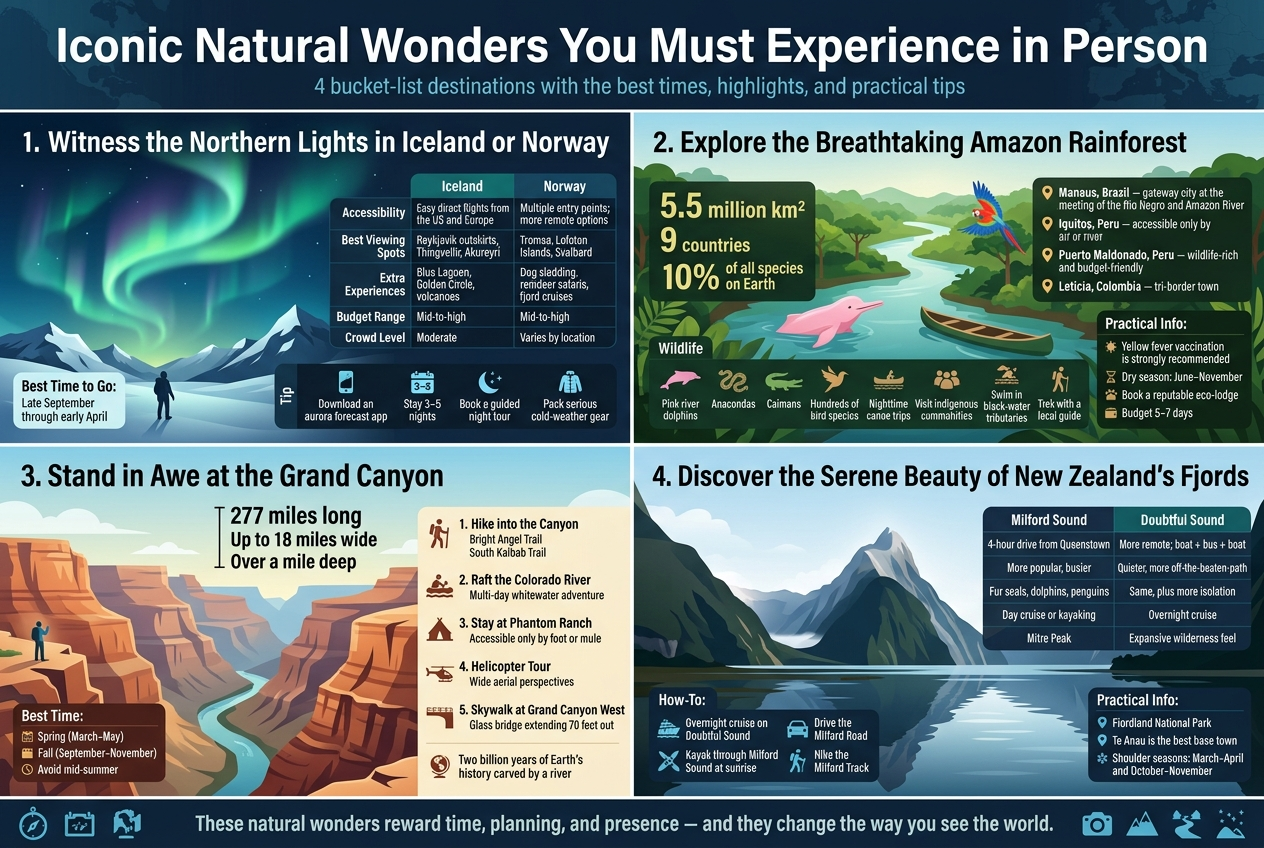
Best Time to Go: The prime viewing window runs from late September through early April, when nights are long and dark enough for the lights to show off.
Iceland vs. Norway — Which Should You Choose?
| Feature | Iceland | Norway |
|---|---|---|
| Accessibility | Easy direct flights from the US and Europe | Multiple entry points; more remote options |
| Best Viewing Spots | Reykjavik outskirts, Thingvellir, Akureyri | Tromsø, Lofoten Islands, Svalbard |
| Extra Experiences | Blue Lagoon, Golden Circle, volcanoes | Dog sledding, reindeer safaris, fjord cruises |
| Budget Range | Mid-to-high | Mid-to-high |
| Crowd Level | Moderate | Varies by location |
Iceland also lets you layer in incredible geothermal pools, black sand beaches, and volcanic landscapes into a single trip. Norway, on the other hand, gives you the deep wilderness feel — especially up in Tromsø, where you can chase the lights on a husky sled through snow-covered forests.
Quick Tips for Aurora Hunting:
- Download a reliable aurora forecast app like SpaceWeather or My Aurora Forecast
- Stay at least 3–5 nights to increase your chances of a clear sky
- Book a guided night tour — local guides know the best dark-sky spots away from light pollution
- Pack serious cold-weather gear; temperatures drop fast after dark
This is one of those bucket list trips in your 30s that genuinely rewires how you see the world. You come back different.
Explore the Breathtaking Amazon Rainforest
The Amazon isn’t just a forest — it’s a living, breathing world unto itself. Covering over 5.5 million square kilometers and stretching across nine countries, it holds roughly 10% of all species on Earth. Walking beneath its canopy, listening to sounds you’ve never heard before, watching the river shift from murky brown to clear black water — it’s an assault on the senses in the most wonderful way.
Where to Base Yourself:
- Manaus, Brazil – The classic gateway city, sitting right at the meeting of the Rio Negro and Amazon River
- Iquitos, Peru – Only accessible by air or river, which immediately tells you how wild it is out here
- Puerto Maldonado, Peru – Great for wildlife density and more budget-friendly lodge options
- Leticia, Colombia – A unique tri-border town where Brazil, Peru, and Colombia meet
What You Can Expect to See and Do:
- Spot pink river dolphins, anacondas, caimans, and hundreds of bird species
- Take nighttime canoe trips to see the forest come alive after dark
- Visit indigenous communities and learn how people have lived alongside the river for centuries
- Swim in black-water tributaries (they’re surprisingly safe and hauntingly beautiful)
- Trek through dense jungle with a local guide who can spot things your eyes would completely miss
The Amazon sits firmly on the list of must-see natural wonders, and for good reason. There’s genuinely nowhere else like it. Go before the crowds find it — and before age makes the humidity and humidity feel less manageable. Your 30s body will thank you.
Practical Things to Know:
- Yellow fever vaccination is strongly recommended before entering
- Dry season (June–November) means better wildlife viewing and fewer mosquitoes
- Always book through a reputable eco-lodge — responsible tourism matters enormously here
- Budget at least 5–7 days to actually feel the rhythm of the forest
Stand in Awe at the Grand Canyon
Photos of the Grand Canyon are everywhere. You’ve probably seen thousands of them. And yet, the moment you walk up to the rim for the first time, your brain genuinely struggles to process the scale of what you’re looking at. It’s 277 miles long, up to 18 miles wide, and over a mile deep — and those numbers mean absolutely nothing until you’re actually standing there.
Ways to Experience It Beyond the Rim:
The South Rim viewpoints are spectacular, but they’re just the beginning. The Grand Canyon rewards those who go deeper — literally.
- Hike into the Canyon: The Bright Angel Trail and South Kaibab Trail are two of the most rewarding hikes you’ll do in your life. Going down is easy; coming back up in the heat is a serious workout. Start early, carry way more water than you think you need, and turn around before you’re exhausted.
- Raft the Colorado River: A multi-day rafting trip through the canyon floor is one of the most epic adventure travel ideas in North America. You’ll pass towering canyon walls, ancient Native American ruins, and rapids that’ll make your heart race.
- Stay at Phantom Ranch: The only lodging at the canyon’s bottom, accessible only by foot or mule. Booking fills up fast — sometimes a year in advance — but it’s worth the effort.
- Helicopter Tour: If hiking isn’t your thing, a helicopter tour gives you jaw-dropping aerial perspectives that are hard to put into words.
- Skywalk at Grand Canyon West: A glass bridge extending 70 feet out over the canyon. Not for the faint-hearted, but unforgettable.
Best Times to Visit:
- Spring (March–May): Mild temperatures, blooming wildflowers, fewer crowds than summer
- Fall (September–November): Golden light, cooler hiking conditions, stunning colors
- Avoid mid-summer: Temperatures at the canyon floor can exceed 110°F, which makes hiking genuinely dangerous
The Grand Canyon belongs on every best travel destinations before 40 list — not because it’s trendy, but because it gives you a real sense of geological time that’s almost impossible to grasp anywhere else. Standing there, you’re looking at two billion years of Earth’s history carved by a river. That perspective stays with you.
Discover the Serene Beauty of New Zealand’s Fjords
If you’ve ever wanted to feel like you’ve stepped inside a painting, New Zealand’s Fiordland National Park is the place. Milford Sound and Doubtful Sound are two of the most serene, other-worldly places you can visit on this planet — sheer granite cliffs dropping straight into dark, mirror-still water, cascading waterfalls at every turn, and a mist that hangs in the valleys like something from a fairy tale.
Milford Sound vs. Doubtful Sound:
| Feature | Milford Sound | Doubtful Sound |
|---|---|---|
| Accessibility | 4-hour drive from Queenstown | More remote; requires boat + bus + boat |
| Crowd Level | More popular, busier | Quieter, more off-the-beaten-path |
| Wildlife | Fur seals, dolphins, penguins | Same, plus more isolation |
| Best Experience | Day cruise or kayaking | Overnight cruise |
| Scenery Highlight | Mitre Peak | Expansive wilderness feel |
How to Get the Most Out of Fiordland:
- Book an overnight cruise on Doubtful Sound – Waking up in total silence on a fiord with no other sounds except water and birds is genuinely life-changing
- Kayak through Milford Sound at sunrise – Before the day-tour boats arrive, the water is glass-smooth and the light is extraordinary
- Drive the Milford Road – The journey there is half the experience, passing through alpine meadows, ancient beech forests, and the Homer Tunnel
- Hike the Milford Track – One of the most famous multi-day hikes in the world, often called “the finest walk in the world.” Book months — sometimes over a year — in advance
New Zealand as a whole ranks among the most life-changing travel destinations you’ll visit in your 30s, but Fiordland is its crown jewel. The combination of raw wilderness, total quiet, and scenery that looks digitally enhanced even when you’re standing in it makes this a place that’s genuinely hard to leave.
Practical Info:
- Fiordland sits in the Te Anau region of the South Island
- Te Anau is the best base town — smaller and more peaceful than Queenstown
- Combine this with a road trip through the South Island for maximum impact
- New Zealand’s shoulder seasons (March–April and October–November) offer beautiful weather with thinner crowds
Cultural Destinations That Will Change Your Perspective
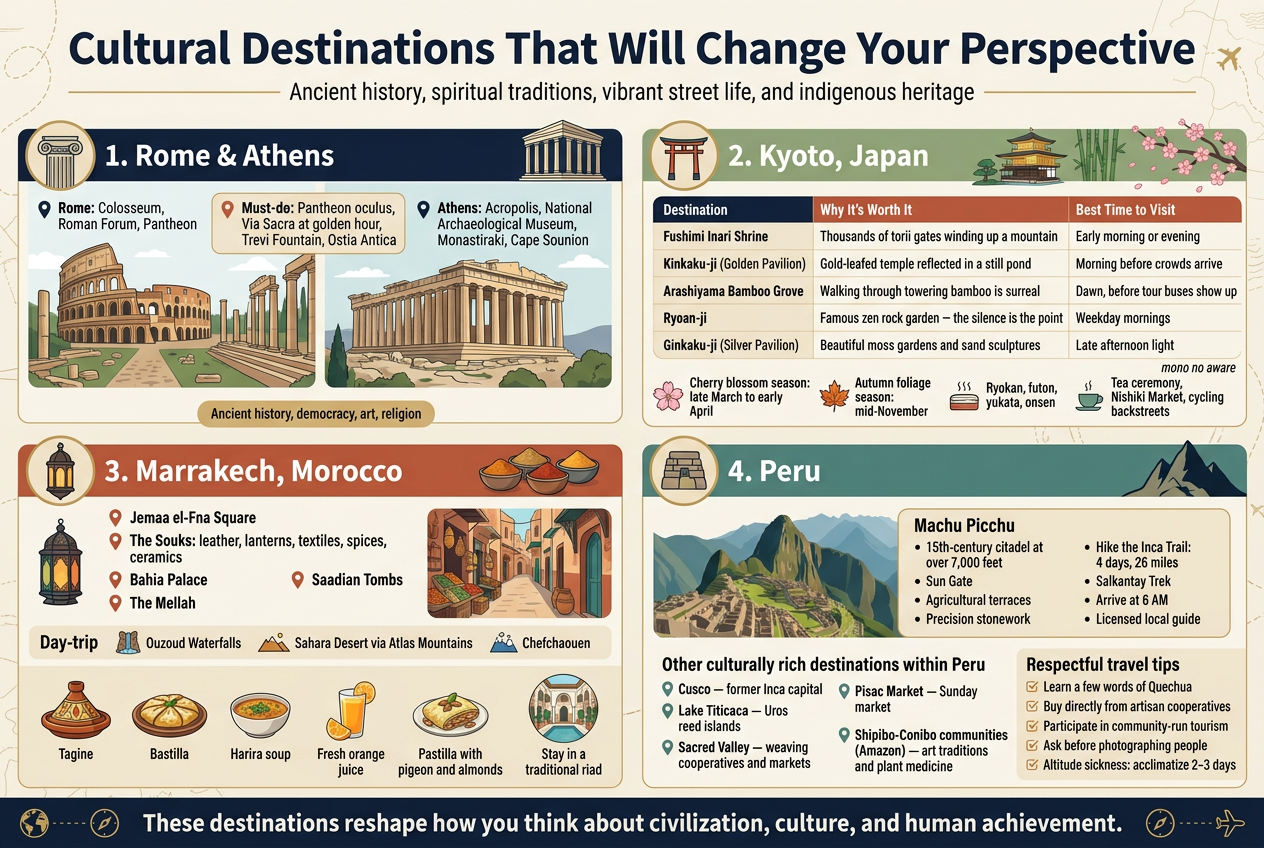
Immerse Yourself in the Ancient History of Rome and Athens
Walking through Rome feels like stepping into a living museum. The difference is you can grab a gelato while doing it. Everywhere you turn, there’s something that predates modern civilization by thousands of years — the Colosseum, the Roman Forum, the Pantheon. These aren’t just photo ops; they’re places where you can genuinely feel the weight of history pressing against you.
Key experiences to prioritize in Rome:
- Standing inside the Pantheon and looking up at the oculus (it’s free entry and mind-blowing every single time)
- Walking the Via Sacra through the Roman Forum at golden hour
- Tossing a coin into the Trevi Fountain — yes, it’s touristy, but it’s touristy for a reason
- Day-tripping to Ostia Antica for a quieter, equally impressive ancient Roman site
Athens operates at a different frequency. It’s grittier, louder, and rawer than Rome, but the Acropolis sitting high above the city skyline is one of those views that genuinely stops you in your tracks. Climbing up to the Parthenon at sunrise, before the tour groups arrive, is one of those bucket list trips in your 30s that will stick with you for decades.
What makes Athens special beyond the obvious:
- The National Archaeological Museum holds artifacts that most people don’t know exist
- The Monastiraki flea market area gives you a chaotic, colorful slice of modern Greek life
- Cape Sounion, about an hour from Athens, has a temple to Poseidon perched on a cliff above the Aegean Sea — deeply underrated
Between these two cities alone, you’re getting thousands of years of democracy, art, religion, and human drama laid out in front of you. These are genuinely life-changing travel destinations that reshape how you think about civilization itself.
Explore the Spiritual Temples of Kyoto, Japan
Kyoto operates at a pace that the rest of the world seems to have forgotten. While Tokyo dazzles with its speed and neon energy, Kyoto does the opposite — it slows everything down and asks you to pay attention.
There are over 1,600 Buddhist temples and 400 Shinto shrines in this city. You won’t see them all, and honestly you shouldn’t try. A handful of deeply experienced visits will do far more for you than a rushed checklist approach.
Temples and shrines worth building your trip around:
| Destination | Why It’s Worth It | Best Time to Visit |
|---|---|---|
| Fushimi Inari Shrine | Thousands of torii gates winding up a mountain | Early morning or evening |
| Kinkaku-ji (Golden Pavilion) | Gold-leafed temple reflected in a still pond | Morning before crowds arrive |
| Arashiyama Bamboo Grove | Walking through towering bamboo is surreal | Dawn, before tour buses show up |
| Ryoan-ji | Famous zen rock garden — the silence is the point | Weekday mornings |
| Ginkaku-ji (Silver Pavilion) | Beautiful moss gardens and sand sculptures | Late afternoon light |
Kyoto during cherry blossom season (late March to early April) or autumn foliage season (mid-November) hits differently. The colors are almost aggressively beautiful. That said, these periods are peak tourist times, so booking accommodation months in advance isn’t optional — it’s survival.
Beyond the temples, don’t miss:
- A tea ceremony in Higashiyama district
- Exploring the Nishiki Market (nicknamed “Kyoto’s Kitchen”)
- Staying at a traditional ryokan (Japanese inn) for at least one night — sleeping on a futon, wearing a yukata, soaking in an onsen bath
- Cycling through the backstreets of the Fushimi neighborhood
This is one of those cultural travel experiences where slowing down is actually the whole point. There’s a Japanese concept called mono no aware — the bittersweet awareness of impermanence. Kyoto teaches it to you without saying a word.
Uncover the Vibrant Street Culture of Marrakech, Morocco
Marrakech is an assault on the senses in the best possible way. The smell of spices, the sound of call to prayer echoing across terracotta rooftops, the maze-like alleyways of the medina that somehow manage to disorient you no matter how many times you’ve checked your map — this city doesn’t let you stay passive.
The medina of Marrakech is a UNESCO World Heritage Site, and once you step inside its walls, you’ll understand why instantly. It’s been a trading hub for centuries, and the souks (markets) still operate with that same chaotic, electric energy.
What to explore in the Marrakech medina:
- Jemaa el-Fna Square — The heart of city life. Snake charmers, storytellers, food stalls, henna artists, and musicians all share the same chaotic space. Go during the day, then come back at night when it transforms completely.
- The Souks — Each section specializes in something different: leather goods, lanterns, textiles, spices, ceramics. Bargaining is expected and even enjoyed. Don’t take it personally.
- Bahia Palace — A 19th-century palace with intricate tilework and carved cedar ceilings that will leave you genuinely speechless.
- Saadian Tombs — Hidden for centuries, rediscovered in 1917, and absolutely stunning.
- The Mellah (Jewish Quarter) — Often overlooked by tourists, but rich in history and architecture.
Day trips that make the visit even richer:
- The Ouzoud Waterfalls (about 3 hours away)
- A night in the Sahara Desert via a drive through the Atlas Mountains
- The blue city of Chefchaouen if you’re willing to extend your trip
Staying in a traditional riad (a house built around an interior courtyard) is essentially non-negotiable for the full experience. Many are surprisingly affordable and far more atmospheric than any hotel chain could ever offer.
Food alone is a reason to visit. Tagine, bastilla, harira soup, fresh-squeezed orange juice from street carts, and pastilla with pigeon and almonds — Moroccan cuisine is complex, layered, and deeply tied to the country’s cultural identity.
Marrakech belongs on every travel bucket list before 40. It challenges your assumptions, disorients your comfort zone, and leaves you with a deeper respect for a culture that has centuries of artistry and tradition woven into its everyday life.
Connect With Indigenous Traditions in Peru
Peru is one of those destinations that operates on multiple levels at once. On the surface, it’s dramatic landscapes — the Andes, the Amazon, the desert coast. But underneath all of that is one of the most complex and layered indigenous cultures on the planet, much of it still alive and practiced today.
Machu Picchu is the obvious starting point, and it deserves every bit of its reputation. Built in the 15th century at over 7,000 feet above sea level, the Inca citadel is one of the most remarkable human achievements in history. The Sun Gate, the agricultural terraces, the precision stonework — it’s jaw-dropping regardless of how many photos you’ve seen beforehand.
How to experience Machu Picchu beyond the standard tour:
- Hike the Inca Trail (4 days, 26 miles) for an approach that feels earned and emotional
- Consider the Salkantay Trek as a less crowded but equally stunning alternative
- Arrive at Aguas Calientes the night before and enter the site at opening time (6 AM) to beat crowds
- Hire a licensed local guide — the context they provide transforms the visit from sightseeing to genuine understanding
But Peru’s indigenous culture extends far beyond Machu Picchu, and the best cultural travel experiences here happen when you slow down and go deeper.
Other culturally rich destinations within Peru:
| Location | Cultural Experience |
|---|---|
| Cusco | The former Inca capital, blending Spanish colonial and indigenous Andean architecture |
| Lake Titicaca | Floating reed islands built and inhabited by the Uros people for centuries |
| Sacred Valley | Living indigenous communities, traditional weaving cooperatives, and local markets |
| Pisac Market | Sunday market where Quechua-speaking locals trade goods the same way their ancestors did |
| Shipibo-Conibo communities (Amazon) | Indigenous art traditions and plant medicine practices still in active use |
Practical tips for respectful engagement:
- Learn a few words of Quechua — locals genuinely appreciate the effort
- Buy directly from artisan cooperatives rather than middlemen in tourist shops
- Participate in a community-run tourism experience rather than a large commercial tour
- Ask before photographing people, especially in traditional dress
Altitude sickness is real in Cusco (11,200 feet) and Machu Picchu. Give yourself 2-3 days to acclimatize before any serious hiking. Coca tea is widely available and genuinely helps.
Peru is the kind of destination that makes you rethink what “civilization” means and how we measure human achievement. The Inca built road systems, astronomical observatories, and agricultural terraces without iron tools, wheels, or written language. Experiencing what remains of that culture — especially through the eyes of people who are still living it — is one of the most powerful and humbling things you can do before 40.
Adventure Travel Experiences Worth the Thrill
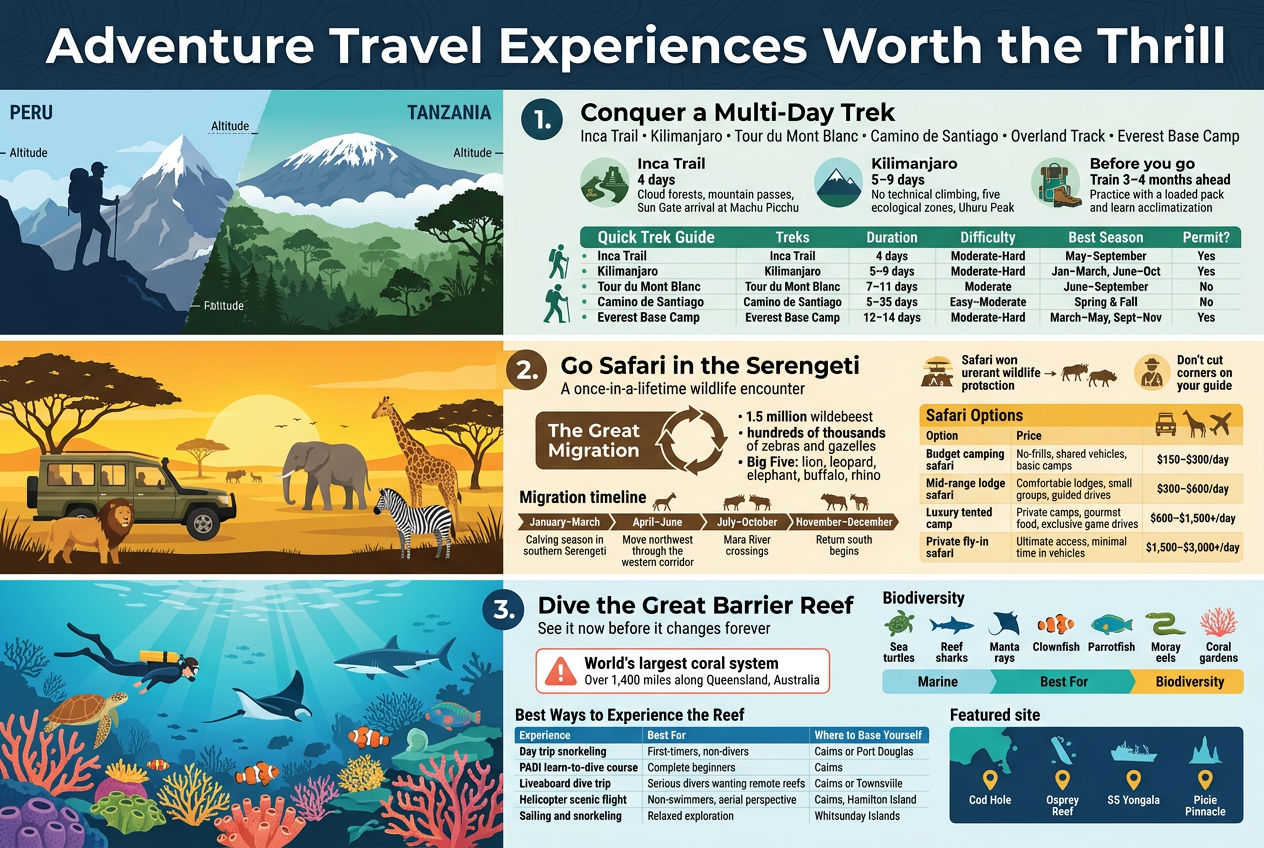
Conquer a Multi-Day Trek Like the Inca Trail or Kilimanjaro
Your 30s are arguably the sweet spot for tackling a serious multi-day trek. You’ve got enough life experience to appreciate what you’re doing, your body is still strong enough to handle the physical demands, and you likely have the financial means to do it properly — with the right gear, proper preparation, and maybe even a guide.
The Inca Trail in Peru is one of the most celebrated hiking routes on the planet, and for good reason. Over four days, you’ll wind through cloud forests, past Incan ruins, and over mountain passes that sit above 13,000 feet before emerging at the Sun Gate for your first jaw-dropping view of Machu Picchu. That moment — arriving at one of the world’s most iconic archaeological sites on foot after days of hiking — hits completely differently than stepping off a bus.
Mount Kilimanjaro in Tanzania tells a different story. Africa’s highest peak doesn’t require technical climbing skills, which surprises a lot of people. What it does require is mental grit, solid fitness, and serious respect for altitude. You’ll pass through five distinct ecological zones — from tropical rainforest to arctic summit — in the span of a few days. Standing at Uhuru Peak at 19,341 feet is the kind of thing that stays with you for the rest of your life.
Other Worthy Multi-Day Treks to Consider
- The Tour du Mont Blanc (France, Italy, Switzerland) — 11 days circling Europe’s highest peak through three countries
- The Camino de Santiago (Spain) — a historic pilgrimage route with incredible cultural depth
- The Overland Track (Tasmania, Australia) — wild, remote, and stunningly beautiful
- Everest Base Camp Trek (Nepal) — not a summit attempt, but an unforgettable high-altitude experience
What to Know Before You Go
| Trek | Duration | Difficulty | Best Season | Permit Required? |
|---|---|---|---|---|
| Inca Trail | 4 days | Moderate-Hard | May–September | Yes (book months ahead) |
| Kilimanjaro | 5–9 days | Moderate-Hard | Jan–March, June–Oct | Yes |
| Tour du Mont Blanc | 7–11 days | Moderate | June–September | No |
| Camino de Santiago | 5–35 days | Easy-Moderate | Spring & Fall | No |
| Everest Base Camp | 12–14 days | Moderate-Hard | March–May, Sept–Nov | Yes |
One practical tip: don’t cheap out on training. The number one reason people don’t complete these treks isn’t lack of will — it’s lack of preparation. Start training at least three to four months out, prioritize hiking with a loaded pack, and if you’re heading to altitude, learn about acclimatization before you go.
Go Safari in the Serengeti for a Once-in-a-Lifetime Wildlife Encounter
There’s a specific kind of silence that falls over a game vehicle when a lion walks past at arm’s length. No photograph, no nature documentary, no story told over dinner even comes close to preparing you for what a safari in the Serengeti National Park actually feels like. It’s one of those experiences that genuinely rewires your brain a little.
Tanzania’s Serengeti is widely considered the gold standard of African safari destinations, and it earns that reputation every single time. Covering nearly 6,000 square miles, it’s home to the Big Five — lion, leopard, elephant, buffalo, and rhino — along with cheetahs, wild dogs, hippos, zebras, and more species of wildlife than most people will ever see in their lifetimes.
The Great Migration: Nature’s Greatest Spectacle
If there’s one natural event that belongs on every adventure travel bucket list before 40, it’s the Great Migration. Each year, roughly 1.5 million wildebeest, along with hundreds of thousands of zebras and gazelles, make a circular journey across the Serengeti and into Kenya’s Masai Mara in search of fresh grass and water. The river crossings — where massive herds plunge into crocodile-filled waters — are among the most dramatic wildlife events anywhere on earth.
Best times to catch the migration by region:
- January–March: Calving season in the southern Serengeti (Ndutu area) — thousands of wildebeest calves born within weeks
- April–June: Herds move northwest through the western corridor
- July–October: River crossings at the Mara River — the most dramatic and most sought-after viewing
- November–December: Return south begins
Safari Options: What Fits Your Style and Budget
| Safari Style | Experience | Price Range |
|---|---|---|
| Budget camping safari | No-frills, shared vehicles, basic camps | $150–$300/day |
| Mid-range lodge safari | Comfortable lodges, small groups, guided drives | $300–$600/day |
| Luxury tented camp | Private camps, gourmet food, exclusive game drives | $600–$1,500+/day |
| Private fly-in safari | Ultimate access, minimal time in vehicles | $1,500–$3,000+/day |
You don’t need to max out your credit card to have a genuinely incredible safari experience, but don’t cut corners on your guide. A skilled, knowledgeable guide makes an enormous difference — they know animal behavior, track movement patterns, and can read the bush in ways that transform a good game drive into an extraordinary one.
Pairing Your Safari With More of East Africa
While you’re in Tanzania, a lot of travelers combine their Serengeti safari with:
- Ngorongoro Crater — a collapsed volcanic caldera with an incredibly dense wildlife population
- Zanzibar — a spice island off the coast with stunning beaches, great diving, and a fascinating Swahili culture
- Kilimanjaro — already mentioned above, but the combination of a summit attempt followed by a Serengeti safari is the kind of East Africa trip that people spend years planning and the rest of their lives talking about
Dive the Great Barrier Reef Before It Changes Forever
Honest truth: the Great Barrier Reef is not the same as it was twenty years ago, and climate scientists are clear that continued ocean warming will keep pushing it toward further bleaching events. That’s not meant to be alarmist — it’s the reason why diving or snorkeling here is one of the most urgent items on any adventure travel bucket list before 40. The reef is still spectacular. It’s still the world’s largest coral system, stretching over 1,400 miles along the Queensland coast of Australia. But it’s changing, and seeing it now matters.
Why the Great Barrier Reef Is Still Worth It
Despite the challenges it faces, the reef remains one of the most biodiverse marine environments anywhere on the planet. On a single dive, you might encounter:
- Sea turtles gliding effortlessly past coral formations
- Reef sharks (mostly harmless, genuinely thrilling) patrolling the outer walls
- Manta rays with wingspans wider than you are tall
- Clownfish, parrotfish, moray eels, and thousands of other species
- Coral gardens in areas that have recovered beautifully from earlier bleaching
Certain sections of the reef — particularly the Coral Sea and the outer ribbon reefs accessible from Cairns and Port Douglas — remain in outstanding condition and offer world-class diving.
Best Ways to Experience the Reef
| Experience | Best For | Where to Base Yourself |
|---|---|---|
| Day trip snorkeling | First-timers, non-divers | Cairns or Port Douglas |
| PADI learn-to-dive course | Complete beginners | Cairns (huge dive school scene) |
| Liveaboard dive trip | Serious divers wanting remote reefs | Cairns or Townsville |
| Helicopter scenic flight | Non-swimmers, aerial perspective | Cairns, Hamilton Island |
| Sailing and snorkeling | Relaxed exploration | Whitsunday Islands |
Top Dive Sites Worth Knowing
- Cod Hole (Ribbon Reef No. 10) — famous for giant potato cod that swim right up to divers
- Osprey Reef (Coral Sea) — remote, crystal-clear water, exceptional shark encounters
- SS Yongala (near Townsville) — one of the world’s best wreck dives, covered in marine life
- Pixie Pinnacle — a seamount draped in soft corals with strong current diving
If you’re not a certified diver yet, there’s genuinely no better motivation to get your PADI Open Water certification than knowing a Great Barrier Reef liveaboard is waiting for you at the end of it. Most liveaboards combine multiple dives per day across three to seven days, giving you access to remote outer reef sites that day-trippers never reach. The difference in water clarity, coral health, and wildlife encounters between the inner reef and the outer reef is significant — and a liveaboard is how you get there.
Luxury and Relaxation Destinations You Deserve in your travel bucket list ideas
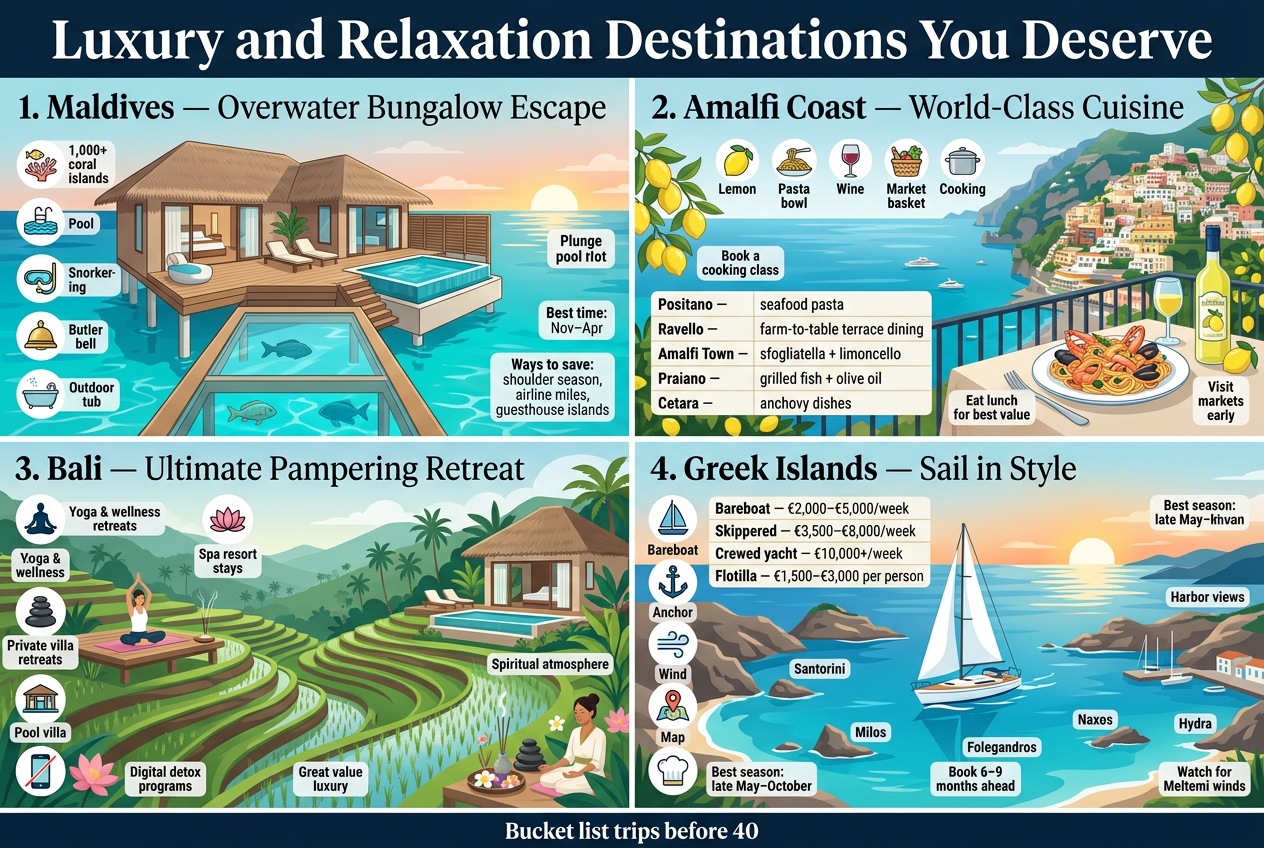
Unwind in an Overwater Bungalow in the Maldives
Few places on earth feel as genuinely otherworldly as the Maldives. Picture waking up to the sound of gentle waves beneath your feet, stepping off your private deck straight into crystal-clear turquoise water, and watching the sun melt into the Indian Ocean from your very own outdoor bathtub. This is exactly the kind of luxury travel destination that belongs on every bucket list before 40.
The Maldives is made up of over 1,000 coral islands spread across 26 natural atolls, and the overwater bungalow experience here is truly in a class of its own. Resorts like Soneva Fushi, Gili Lankanfushi, and the iconic Conrad Maldives Rangali Island have set the global standard for what overwater living should feel like.
What to expect from an overwater bungalow stay:
- Glass floor panels that let you watch fish swim beneath you from the comfort of your living room
- Private plunge pools perched directly over the lagoon
- Snorkeling and diving access right from your deck, with some of the world’s most vibrant coral reefs within arm’s reach
- Butler service that anticipates your every need before you even realize you have one
- Outdoor showers and soaking tubs positioned to give you the most dramatic ocean views imaginable
The best time to visit is between November and April, when the weather is dry and the seas are calm. While the Maldives has a reputation for being expensive, there are ways to make it more accessible. Booking during the shoulder season (May or October), using airline miles for flights, or choosing a guesthouse island instead of a private resort can trim costs significantly without sacrificing the magic.
This is one of those bucket list trips in your 30s that you’ll talk about for the rest of your life. The complete disconnection from the everyday world, the surreal beauty of the water, and the absolute indulgence of it all combine into something that is genuinely hard to describe unless you’ve been there.
Indulge in World-Class Cuisine Along the Amalfi Coast
The Amalfi Coast is one of those places that looks almost too beautiful to be real. Colorful cliffside villages tumbling down toward a glittering sea, winding roads with breathtaking views around every turn, and a food culture that will genuinely ruin you for ordinary Italian food forever. If you’re building your best travel destinations before 40, the Amalfi Coast earns a permanent spot near the top.
But beyond the scenery — which is spectacular enough on its own — it’s the food that transforms this from a great trip into a life-changing one.
A taste of what you’ll experience:
| Destination Along the Coast | Must-Try Food Experience |
|---|---|
| Positano | Fresh seafood pasta with local clams and sea urchin |
| Ravello | Intimate farm-to-table dining overlooking the hillside terraces |
| Amalfi Town | Sfogliatella pastry and limoncello made from local Amalfi lemons |
| Praiano | Grilled fish caught the same morning, served with local olive oil |
| Cetara | Anchovy-based dishes that are world-renowned among food lovers |
The lemons here deserve their own special mention. Amalfi lemons are enormous, fragrant, and incomparably sweet compared to what you’ll find in a grocery store back home. The limoncello made from them is a completely different drink — aromatic, silky, and deeply satisfying rather than harshly sweet.
Practical tips for the full Amalfi food experience:
- Book a cooking class in a local home or small restaurant — learning to make fresh pasta or seafood risotto here is an experience that stays with you
- Eat at lunch rather than dinner to get the freshest preparations at often lower prices
- Visit the local markets in Amalfi Town early in the morning before the tourist crowds arrive
- Skip the tourist traps on the main waterfront and walk uphill or into side streets for the restaurants where locals actually eat
Pair all of this with a sunset aperitivo on a terrace overlooking the sea and a leisurely boat trip between villages, and you have the kind of luxury travel experience that doesn’t feel indulgent so much as deeply nourishing.
Experience Ultimate Pampering at a Bali Retreat
Bali has been on the radar of wellness travelers for decades, and there’s a very good reason it hasn’t lost its appeal. The island has a soul to it — a deep spiritual energy rooted in Hindu traditions, lush rice terraces, and a culture that genuinely values balance, beauty, and presence. Coming here for a retreat isn’t just about spa treatments, though those are extraordinary. It’s about resetting your entire relationship with how you move through the world.
Whether you’re drawn to a week-long yoga and meditation retreat in Ubud, a luxury spa resort in Seminyak, or a private villa in the rice fields of Canggu, Bali delivers pampering on a level that most luxury destinations simply can’t match — and often at a fraction of the price.
Types of Bali retreats worth considering:
- Yoga and wellness retreats — Places like The Yoga Barn in Ubud offer everything from beginner classes to deep immersion programs. Combine daily yoga with sound healing, breathwork, and Balinese healing sessions with a local Balian (healer)
- Spa resort stays — COMO Shambhala Estate and Fivelements are widely considered among the best wellness retreats in the world. Expect personalized holistic treatments, Ayurvedic therapies, and organic cuisine that actually tastes incredible
- Private villa retreats — Renting a private villa with a personal chef, pool, and in-villa spa treatments gives you the freedom to design your own pace entirely
- Digital detox programs — Several retreats specifically help you step away from screens, work stress, and decision fatigue through structured programs in naturally beautiful surroundings
What makes Bali different from other spa destinations:
The spiritual backdrop is genuine, not performative. Offerings placed on temple steps, the smell of incense in the morning air, the sound of gamelan music drifting through the trees — all of this creates an atmosphere that actively helps you slow down and reconnect. A traditional Balinese massage here isn’t just a massage. It’s part of something larger.
Bali is also exceptionally good value as a luxury destination. World-class treatments, stunning accommodations, and beautifully prepared food cost significantly less than equivalent experiences in Europe or North America, making it one of the most accessible life-changing travel destinations for people working with a real budget.
Sail the Greek Islands in Style
There’s something about arriving somewhere by sea that changes the experience completely. When you sail into a Greek island harbor — whether it’s the dramatic caldera of Santorini, the lush green shores of Corfu, or the hidden coves of the Cyclades — you arrive feeling like you belong to the place rather than just passing through it.
Sailing the Greek Islands is one of those bucket list trips in your 30s that rewards you on multiple levels simultaneously. You get the freedom to explore small, less-visited islands that ferries and cruise ships never reach. You get the intimacy of waking up anchored in a quiet bay with no one else around. And you get the absolute pleasure of having the sea as your constant companion.
Your main sailing options:
| Option | Best For | Approximate Cost |
|---|---|---|
| Bareboat charter | Experienced sailors who want complete freedom | €2,000–€5,000/week for the boat |
| Skippered charter | Those who want flexibility without needing to sail themselves | €3,500–€8,000/week including skipper |
| Crewed luxury yacht | Full-service sailing with chef, crew, and itinerary planning | €10,000+/week |
| Flotilla sailing holiday | Group sailing with support boat — perfect for beginners | €1,500–€3,000 per person |
Islands worth building your itinerary around:
- Santorini — The iconic caldera views are best appreciated arriving by sea at sunrise
- Milos — Dramatic volcanic rock formations and some of Greece’s most extraordinary beaches
- Folegandros — A quieter, more authentic island that rewards those willing to go a little off the beaten path
- Naxos — The largest of the Cyclades, known for incredible local cheese, produce, and ancient ruins
- Hydra — Completely car-free, architecturally stunning, and blissfully peaceful
Practical things to know before you go:
- The best sailing season runs from late May through October, with July and August being the windiest (which experienced sailors love, but beginners might find challenging)
- Meltemi winds in the Aegean during summer can be strong — check with your charter company about which islands and routes are best suited to conditions when you’re traveling
- Book your charter 6–9 months in advance if you’re going in peak season, especially for the most sought-after boats and departure points like Athens (Piraeus or Lavrion marinas) or Corfu
Few experiences capture the essence of luxury travel destinations quite like anchoring in a secluded Greek cove, swimming in water so clear you can see the bottom from 10 meters up, then heading ashore for grilled octopus and cold white wine as the sun goes down. This is the kind of trip that doesn’t just make it onto your bucket list — it becomes the standard everything else gets measured against.
Smart Tips to Make Your Bucket List a Reality
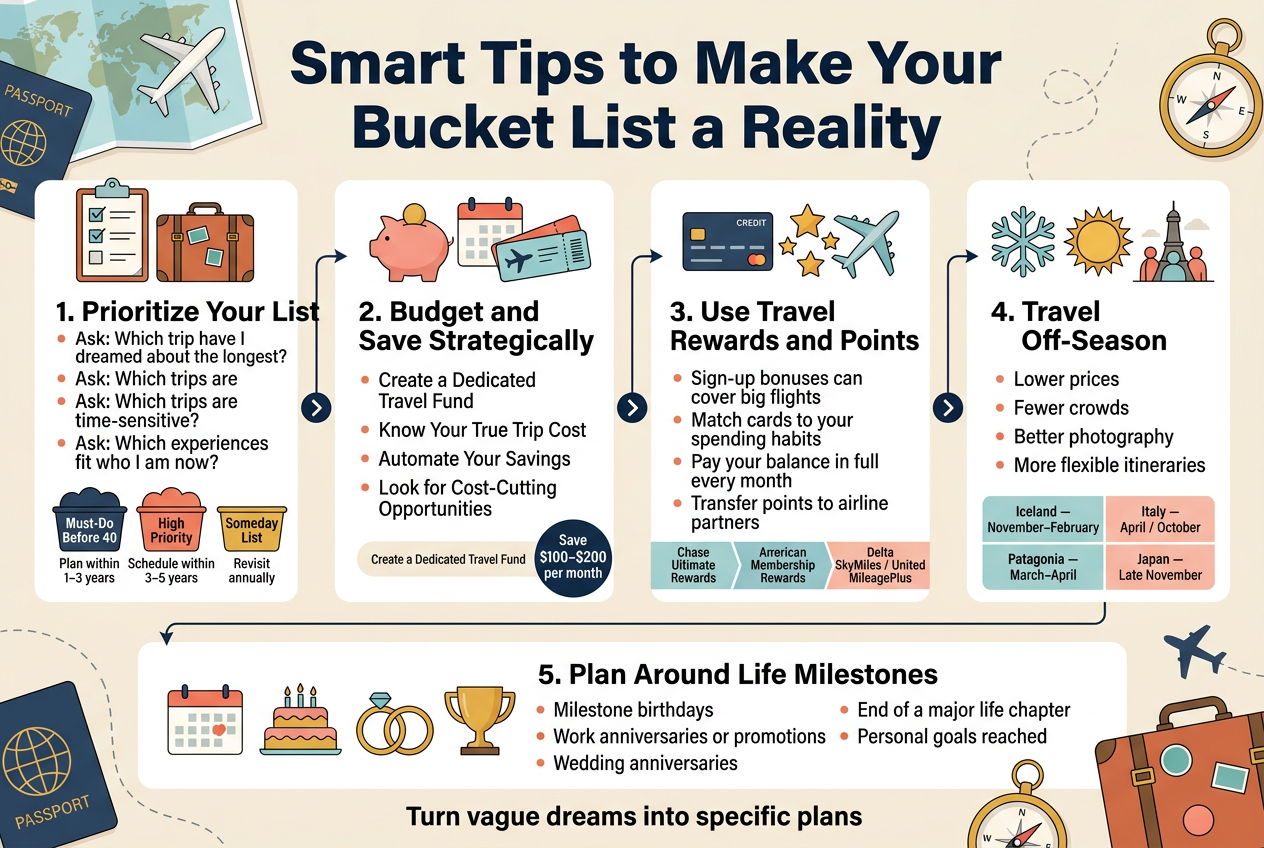
Prioritize Your List to Focus on the Most Meaningful Trips
Not every destination on your bucket list carries the same weight — and that’s completely okay. The key is figuring out which trips genuinely light you up versus which ones you added because they looked good on someone else’s Instagram feed.
Start by asking yourself a few honest questions:
- Which destination have I been dreaming about the longest? Longevity of a dream usually signals genuine desire.
- Which trips are time-sensitive? Some experiences — hiking certain glaciers before they recede further, visiting destinations before overtourism changes them, or doing physically demanding adventures while your body is at peak condition — have a natural deadline.
- Which experiences align with who I am right now? Your 30s are different from your 20s. You likely have a clearer sense of what genuinely moves you.
Try this practical exercise: write down every destination you’ve ever wanted to visit, then sort them into three buckets:
| Priority Level | Description | Action |
|---|---|---|
| Must-Do Before 40 | Deeply personal, time-sensitive, or life-defining | Plan within the next 1–3 years |
| High Priority | Strong desire but more flexibility on timing | Schedule within 3–5 years |
| Someday List | Nice to have, but not urgent | Revisit annually |
Once you have your top five, treat them like real goals — not just wishes. Give each one a rough target year and start working backward from there.
Budget and Save Strategically for Big Travel Goals
Dreaming about bucket list trips in your 30s is exciting. Actually funding them requires a plan that goes beyond cutting out your morning coffee.
Create a Dedicated Travel Fund
Open a separate savings account just for travel. Naming it something specific — like “Patagonia 2026” — makes it feel real and keeps you motivated. Even setting aside $100–$200 per month adds up to $1,200–$2,400 annually, which can seriously move the needle on a big trip.
Know Your True Trip Cost
Before you start saving, get a realistic number. Research:
- Flights — Use tools like Google Flights to track price trends over time
- Accommodation — Mix boutique hotels with vacation rentals to balance comfort and cost
- Activities and experiences — These are often underestimated but can be a huge portion of the budget on adventure or cultural trips
- Travel insurance — Non-negotiable for international bucket list travel; factor it in from the start
- Buffer fund — Add at least 15–20% on top of your estimated total for unexpected costs
Automate Your Savings
Set up an automatic transfer to your travel fund on payday. When the money moves before you ever see it, you won’t miss it. Treat your travel savings like a bill — not optional.
Look for Cost-Cutting Opportunities Without Sacrificing Experience
- Book flights 6–8 weeks out for domestic trips and 3–6 months out for international travel
- Travel in shoulder season (more on that shortly) to get better prices on everything
- Cook some of your own meals on longer trips without giving up the local food experiences that matter
- Choose fewer, better experiences over trying to pack everything in — quality over quantity saves both money and energy
Use Travel Rewards and Points to Cut Costs Significantly
If you’re not using travel rewards cards strategically, you’re leaving real money on the table. Affordable bucket list travel isn’t just about finding deals — it’s about making your everyday spending work double duty.
The Basics of Building Points Fast
- Sign-up bonuses are where the magic starts. Many travel credit cards offer 60,000–100,000 bonus points after hitting a minimum spend threshold. One good sign-up bonus can cover a round-trip international flight.
- Use cards that match your spending habits. If you spend heavily on groceries, find a card that rewards that. If dining out is your thing, prioritize restaurant rewards categories.
- Pay your balance in full every month. Interest charges will wipe out any rewards benefit instantly.
Which Points Programs Are Worth It for Bucket List Travel
| Program | Best For | Key Perk |
|---|---|---|
| Chase Ultimate Rewards | Flexible travel redemptions | Transfer to multiple airline and hotel partners |
| American Express Membership Rewards | Business travelers and luxury hotels | Strong airline transfer options |
| Delta SkyMiles / United MileagePlus | Loyal flyers on specific airlines | Direct redemptions without transfer delays |
| Marriott Bonvoy / Hilton Honors | Hotel stays, especially luxury properties | Free night certificates and status perks |
Practical Tips to Maximize Value
- Transfer points to airline partners rather than booking directly through the card portal when possible — you usually get significantly more value per point
- Book premium cabin seats using points — this is where the value multiplier really shows up; a business class seat worth $4,000 might only cost 60,000–80,000 points
- Stack rewards by booking hotels through the hotel’s own program while paying with a travel credit card
Travel Off-Season to Save Money and Avoid Crowds
One of the smartest moves you can make for bucket list trips in your 30s is simply showing up when everyone else isn’t. Traveling off-season doesn’t mean tolerating bad weather or closed attractions — it means doing your homework and reaping serious rewards.
What Off-Season Actually Looks Like
Off-season varies by destination, so you need to look at each location individually. Here are a few examples:
| Destination | Peak Season | Off-Season Advantage |
|---|---|---|
| Iceland | June–August | Visit November–February for Northern Lights and far fewer tourists |
| Southeast Asia | November–February | April–May (just before monsoon) offers lower prices and manageable crowds |
| Italy | June–August | October and April give you mild weather, fewer tourists, and cheaper flights |
| Patagonia | December–February | March–April offers stunning fall colors with a fraction of the summer crowds |
| Japan | March–April (cherry blossoms) | Late November for fall foliage — equally beautiful but far less crowded |
The Real Benefits Beyond Savings
- Authentic local experiences — Restaurants, markets, and neighborhoods feel more genuine when they’re not catering exclusively to tourists
- Better photography — Iconic landmarks without massive crowds in every shot
- More flexible itineraries — You can often book popular tours or restaurants last-minute instead of planning months in advance
- Shorter lines at major attractions — This alone can transform a visit to somewhere like the Louvre or Machu Picchu from frustrating to magical
What to Watch Out For
Some destinations have an off-season for good reason — think extreme heat, heavy rainfall, or limited services. Always check:
- Average weather conditions by month using historical data, not just travel blog generalizations
- Which specific attractions or tours operate year-round versus seasonally
- Whether accommodation options are more limited during quieter periods
Plan Trips Around Life Milestones to Stay Motivated
One of the best ways to actually check off your bucket list before 40 is to tie travel to moments that already carry meaning. Milestones give you a built-in reason to book the trip, a natural deadline, and a deeper emotional layer to the experience itself.
Milestones That Make Perfect Travel Hooks
- Milestone birthdays — Your 35th or 39th birthday is the perfect excuse to finally book that trip to Japan, Morocco, or New Zealand you’ve been putting off
- Work anniversaries or promotions — Reaching a big professional goal deserves a real celebration, and a trip you’ve been dreaming about is far more memorable than a dinner out
- Wedding anniversaries — Skip the traditional gifts and invest in an experience together instead
- End of a major life chapter — Career transitions, completing a degree, or any significant change is a natural reset point and a great travel opportunity
- Personal goals reached — Paid off debt? Hit a savings milestone? A trip is the perfect reward that also reinforces positive financial habits
How to Use Milestones as Accountability Tools
Once you tie a destination to a specific life event, the trip stops feeling abstract. You’re no longer saying “I want to go to Peru someday” — you’re saying “We’re doing Machu Picchu for our 5th anniversary in 18 months.” That shift from vague dream to specific plan changes everything about how you approach saving, planning, and actually following through.
Build out a simple milestone travel map for the next several years:
- Write down the major life events you anticipate
- Match one meaningful destination to each event
- Set a rough budget and start building toward it
This approach keeps your how to travel in your 30s strategy connected to real life rather than sitting on a list you never look at. The trips become part of your story — not just places you visited, but moments that mark who you were and who you were becoming at each stage of your life.
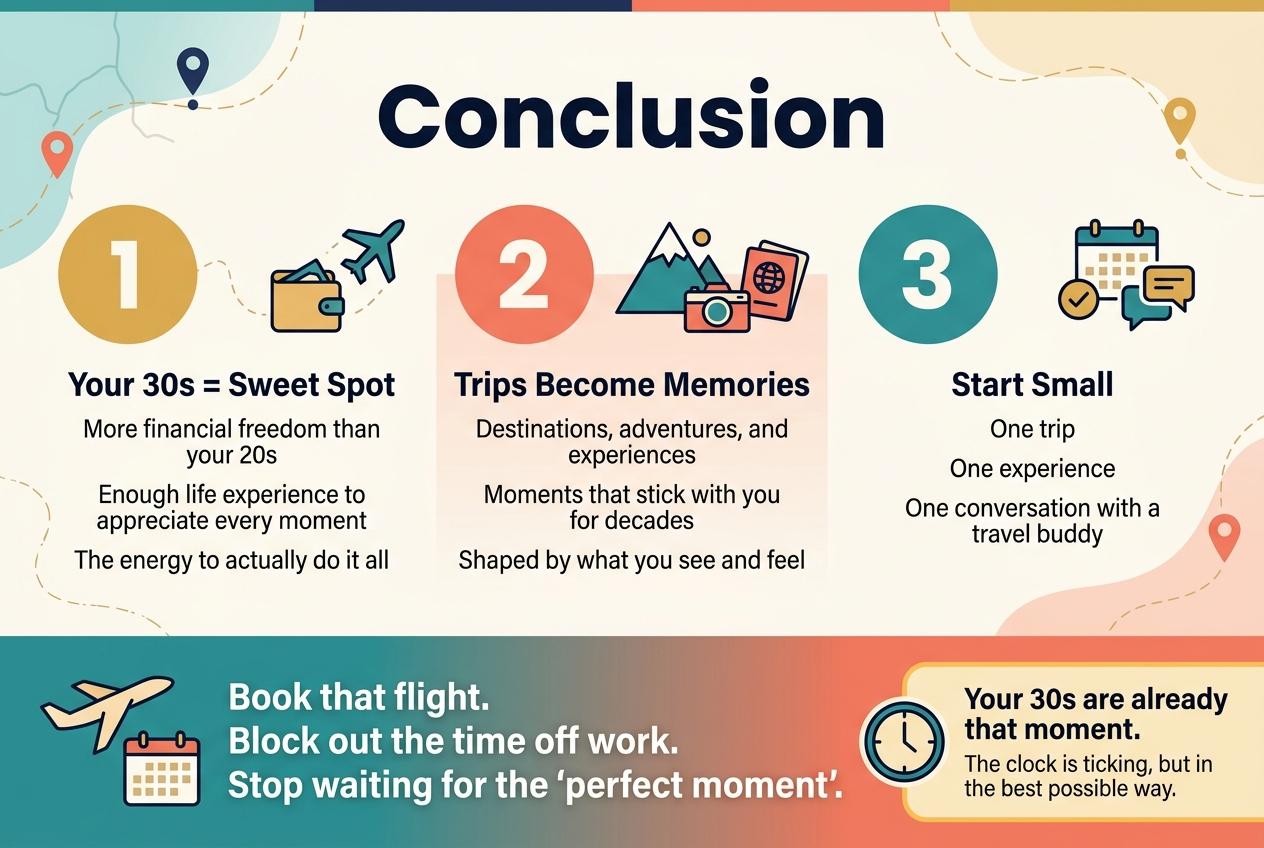
Your 30s are this unique sweet spot where you have more financial freedom than your 20s, enough life experience to truly appreciate what you’re seeing, and the energy to actually do it all. The destinations, adventures, and experiences covered here aren’t just pretty places on a map — they’re the kind of moments that stick with you for decades and shape who you become.
The best part? You don’t have to tackle everything at once. Start with one trip, one experience, or even one conversation with a travel buddy about where you both want to go. Book that flight, block out the time off work, and stop waiting for the “perfect moment” — because your 30s are already that moment. The clock is ticking, but in the best possible way.