What Is Hybrid Parenting? The Only Complete Guide Modern Parents Need in 2026
I still remember the moment I knew gentle parenting wasn’t fully working for my family. My 4-year-old had just knocked over her entire cup of milk, looked me dead in the eyes, and smiled. I took a breath. I got down to her level. I said, calmly, “I see you’re feeling playful. Let’s clean this up together.” She smiled again. And knocked over the second cup.
Y’all. I had been reading every gentle parenting book. I was doing all the things. And yet — something was clearly off.
Turns out, I wasn’t alone. Google searches for “gentle parenting not working” have skyrocketed by over 210% since 2023. Parents are burning out. Kids are struggling with limits. And child psychologists are quietly raising red flags about what happens when connection-based parenting tips into full-on permissiveness.
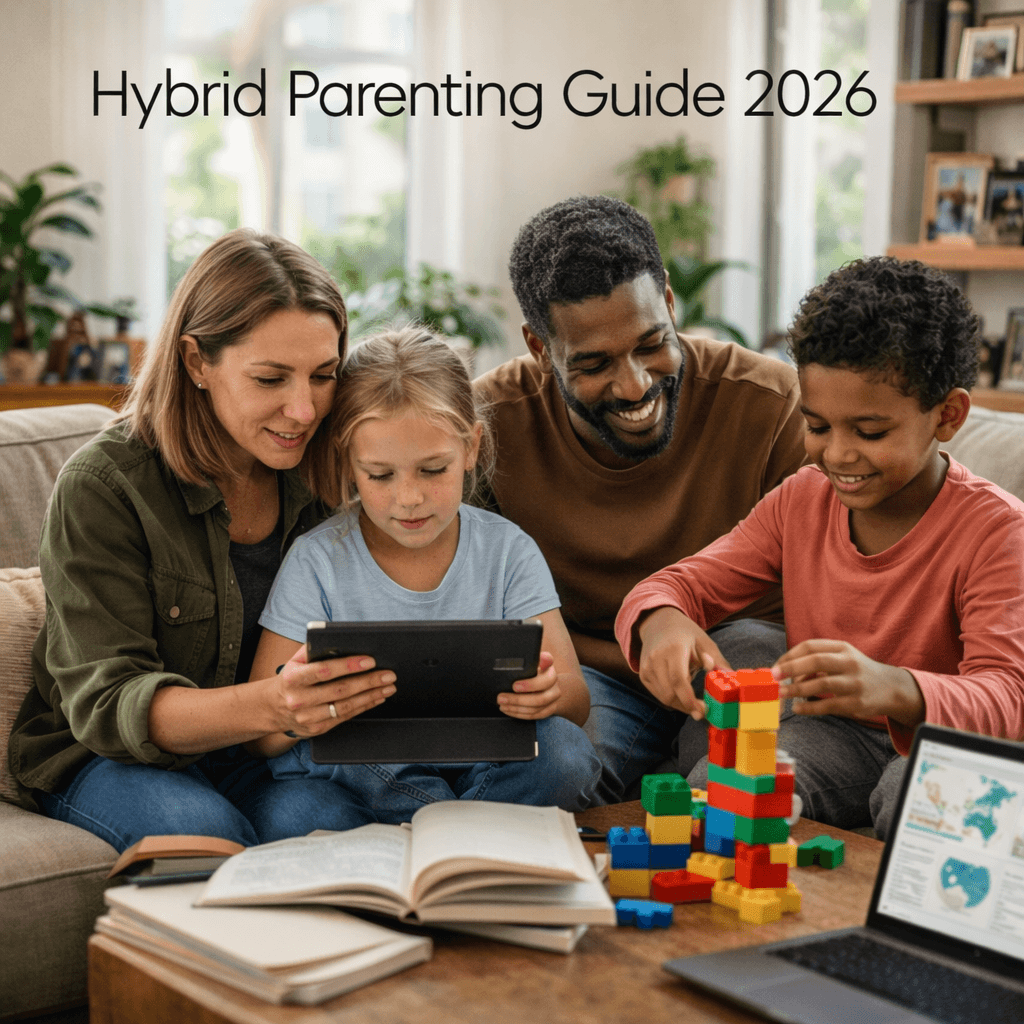
That’s where hybrid parenting comes in. It’s the approach that says: you don’t have to choose between being warm and being firm. You can be both. You should be both. And when you are both — consistently, kindly, and with a clear plan — something really cool happens. Your kids start to actually thrive. And so do you.
This guide covers everything. What hybrid parenting is, how it works at every age, real scenarios you’ll recognize from your own life, the science behind it, mistakes to dodge, and the best resources out there. Let’s get into it!
Key Takeaways — Read This Before Anything Else
- Hybrid parenting = emotional warmth + firm, consistent structure. Both. Not one or the other.
- It’s backed by 50+ years of research on authoritative parenting — this isn’t a trend, it’s science.
- The “internet version” of gentle parenting veered into permissiveness. Hybrid parenting corrects that.
- It scales from newborns to teenagers — no need to switch frameworks as kids grow.
- Consistency beats perfection. Give it 6–8 weeks before judging results.
- Repair after hard moments is built into the model — you don’t have to be perfect to make this work.
1. What Is Hybrid Parenting? (And Why Does It Matter Right Now?)
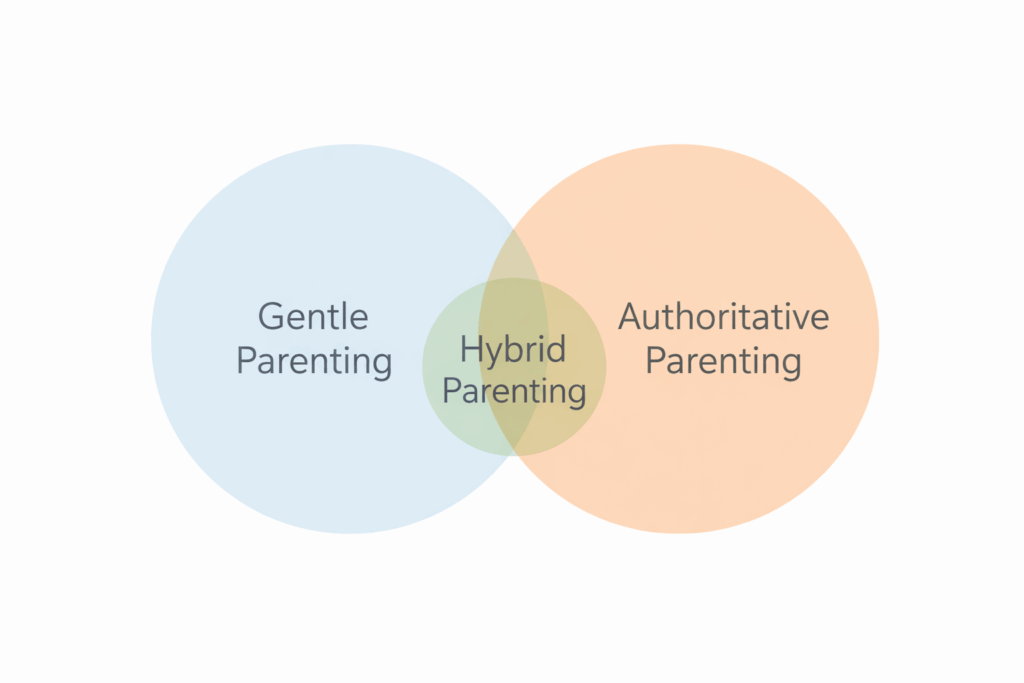
Hybrid parenting is a parenting approach that blends elements from multiple evidence-based styles — most often gentle parenting and authoritative parenting — into something flexible, realistic, and actually sustainable for the average parent who doesn’t have endless patience and unlimited time.
Think of it like a hybrid car. Sometimes you need the electric mode — smooth, quiet, emotionally intelligent. Other times you need the engine — clear, powerful, direct. A hybrid car doesn’t apologize for using both. And neither should you.
It’s worth saying right upfront: if you’re already working on building emotional intelligence in your children, you’re already doing half of hybrid parenting. The warmth and attunement side is something you’ve got. What hybrid parenting adds is the structure and consistency that makes that emotional foundation actually stick.
Where the Term Comes From
Hybrid parenting isn’t a brand. No single book invented it. No influencer owns it. It’s an organic term that emerged as parents — especially Gen Z parents who came of age during the gentle parenting movement — started describing what they were actually doing once they realized neither extreme worked.
Pure gentle parenting, when practiced the way social media presents it, often slides into permissiveness. Meanwhile, old-school strict parenting crushed emotional development. Hybrid parenting sits deliberately in between — and that middle ground is where child development research has pointed for over 50 years.
What Hybrid Parenting Looks Like Day-to-Day
Here’s a concrete picture. Your 6-year-old starts whining about not wanting to do homework. A permissive parent says “okay, do it later” and it never happens. A harsh parent says “sit down NOW, no complaining.” A hybrid parent says: “I hear you — homework is rough after a long day. Snack first, then we get it done. That’s the deal.”
Warmth. Acknowledgment. Non-negotiable expectation. All three in two sentences. That’s hybrid parenting in its most practical form.
Hybrid Parenting vs. Other Styles at a Glance
| Element | Permissive | Authoritarian | Gentle Parenting | Hybrid Parenting |
|---|---|---|---|---|
| Emotional connection | High | Low | Very high | Very high |
| Clear limits | Weak | Rigid | Often blurry | Clear and explained |
| Discipline style | None | Punishment | Redirection only | Empathy + consequences |
| Works under parent stress | Yes (too easily) | Yes (harshly) | Very hard | Manageable |
| Child frustration tolerance | Low | Variable | Often low | Builds over time |
| Repair after conflict | Rarely needed | Rarely done | Central | Always built in |
“The goal of parenting is not to produce happy children. It’s to produce adults who can handle unhappiness — and still function, connect, and grow.”
— Dr. Wendy Mogel, clinical psychologist and author of The Blessing of a Skinned Knee
2. The Rise of Hybrid Parenting in 2026: Why Parents Are Shifting
To understand this moment, you have to understand what happened to gentle parenting on the internet between 2018 and 2024. The core principles are genuinely great. Emotional attunement. Respectful communication. Understanding your child’s internal world. All good stuff, backed by real research.
But social media turned it into a performance. And that’s where it fell apart.
How the Internet Broke Gentle Parenting
TikTok showed parents sitting on the floor narrating every emotion for 40 minutes while their kid screamed. Instagram praised moms who “never said no.” Parenting accounts went viral by making calm, regulation-focused parenting look effortless — and parents who couldn’t pull that off felt like failures.
I felt like a failure. Often. And I was trying really hard.
Here’s what nobody said out loud in those comment sections: the creators themselves weren’t actually parenting like that 24/7. Their kids had limits. They had hard moments. The curated content wasn’t the real story — and a generation of parents absorbed the fake version as the gold standard.
What the Search Data Shows
| Search Term | Monthly Searches | Trend (2023–2026) |
|---|---|---|
| gentle parenting | 33,100 | 📈 Plateauing |
| gentle parenting not working | 8,200 | 📈 +210% fast growth |
| hybrid parenting | 4,400 | 📈 Rapidly emerging |
| authoritative parenting | 12,000 | 📈 Steady resurgence |
| balanced parenting style | 3,600 | 📈 Growing |
| positive discipline | 9,800 | 📈 Consistent |
Real Talk: Pediatric therapists consistently report that children who struggle most with school-based emotional regulation often come from homes where limits were absent — not homes where they were harsh. The missing ingredient isn’t always more empathy. Sometimes it’s the experience of limits delivered with love.
Why Gen Z Parents Are Leading This Correction
Gen Z parents — born roughly 1997–2012, now raising young kids in their mid-to-late 20s — are the most research-aware, mentally health-conscious generation of parents in history. They came of age during a teen mental health crisis. Many experienced anxiety and depression themselves. They read the studies. They follow the actual child psychologists (not just the influencers). And when the evidence doesn’t match the trend, they adjust. That’s exactly what’s driving the hybrid parenting shift.
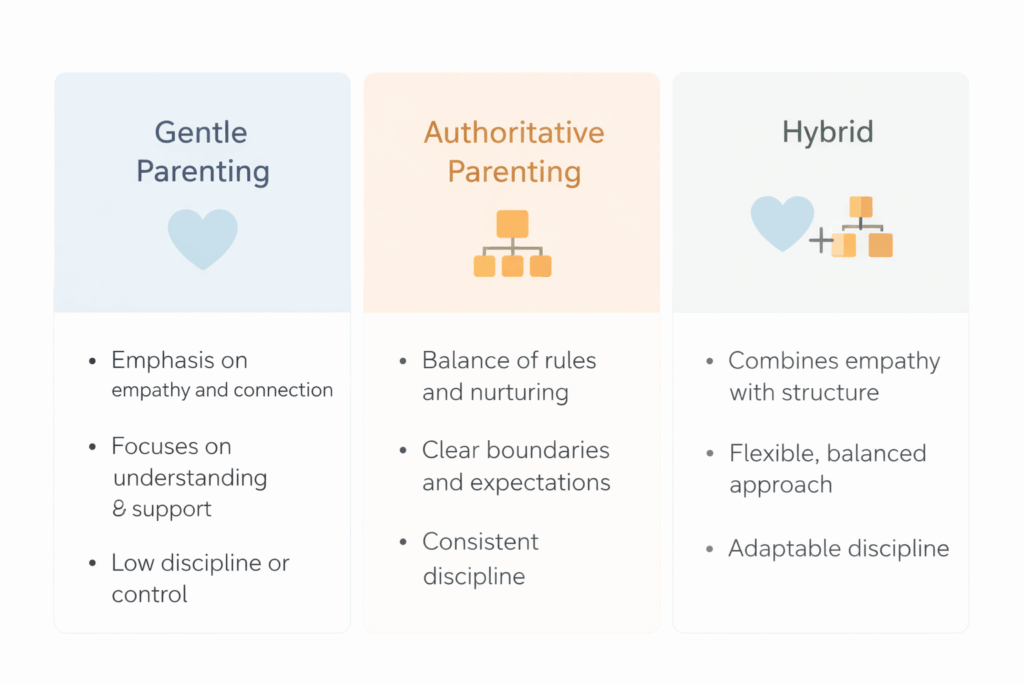
3. Hybrid Parenting vs. Gentle Parenting vs. Authoritative Parenting: The Honest Comparison
Most comparison articles get this wrong. They pit these styles against each other like competing teams. But all three styles share the same foundational goal: raise emotionally healthy, capable, well-adjusted humans. Where they differ is in how they balance warmth, authority, and child autonomy.
What Gentle Parenting Gets Right
Genuinely, a lot. The research on emotional attunement is solid. When parents validate a child’s emotional experience rather than dismissing it, kids develop stronger emotional vocabulary, better self-regulation over time, and more secure attachment. These are real outcomes. The problem is that “validation” got misinterpreted as “agreement.” And “no punishments” got misinterpreted as “no consequences.” Those two translation errors are where the wheels came off.
If you want to go deep on this, my post on emotional intelligence in children covers exactly why the attunement side matters so much — and how to build it without sacrificing structure.
What Authoritative Parenting Gets Right
Everything Baumrind found over 30 years of longitudinal research: kids raised by authoritative parents — warm AND demanding — consistently outperformed every other group. Better academic outcomes. Better social skills. Higher self-esteem. More resilience. Lower rates of anxiety and depression in adulthood. The evidence is overwhelming and has been replicated across cultures and decades.
“Authoritative parents are both responsive and demanding. They monitor and impart clear standards for their children’s conduct. They are assertive, but not intrusive and restrictive.”
— Diana Baumrind, developmental psychologist, UC Berkeley — research spanning 1966–1991
Side-by-Side Comparison
| Category | Gentle Parenting | Authoritative Parenting | Hybrid Parenting |
|---|---|---|---|
| Saying “No” | Reframed as rarely as possible | Clear and direct | Clear, warm, non-negotiable |
| Tantrums | Full emotional coaching always | Brief acknowledgment + correction | Validate, hold limit, reconnect after |
| Chores | Child-led, optional | Required, age-appropriate | Required, explained, celebrated |
| Screen time | Collaboratively negotiated | Parent sets rules | Parent sets rules, child has input |
| Mistakes | No consequence, just learning | Logical consequence applies | Consequence + repair + learning |
| Under parent stress | Very hard to maintain | More sustainable | Most realistic for daily life |
4. The 5 Core Pillars of Hybrid Parenting
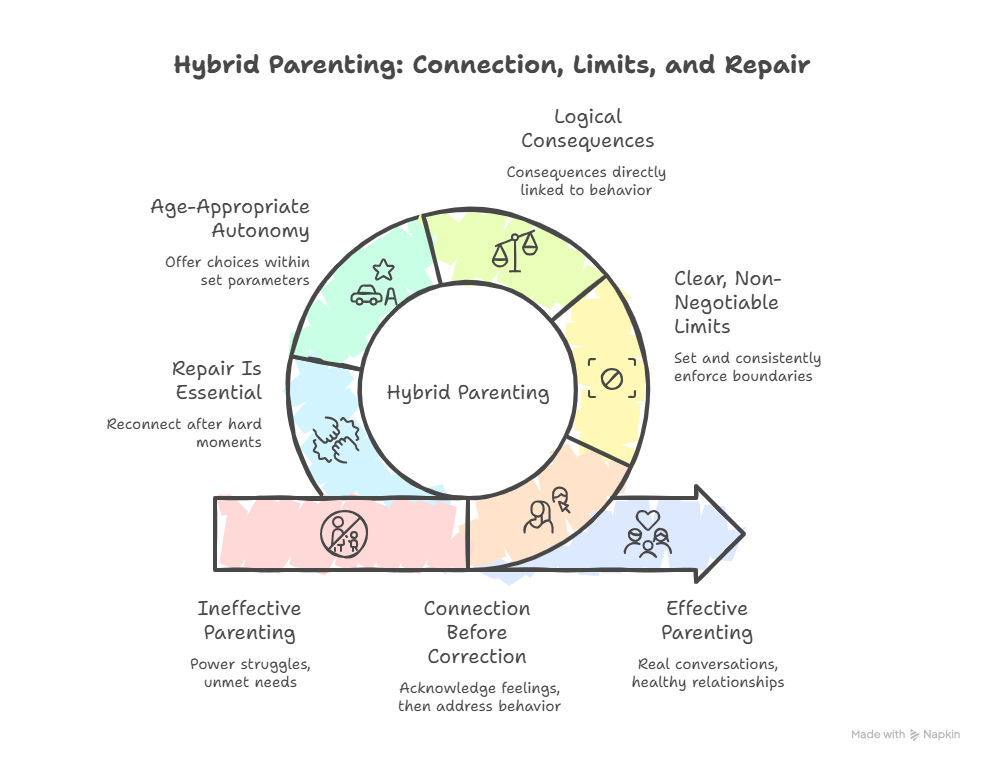
When I tried to articulate what I was actually doing once I found my footing, I kept coming back to five things. Five principles that, when I practiced them consistently, genuinely changed our family dynamic. Not overnight. But steadily, undeniably. Here they are.
Pillar 1: Connection Before Correction
Before you address any behavior, connect first. This doesn’t mean a long emotional processing session every time. It means 15 seconds of being fully present — eye contact, body language that says “I see you,” a brief acknowledgment of what they’re feeling. Then you address the behavior.
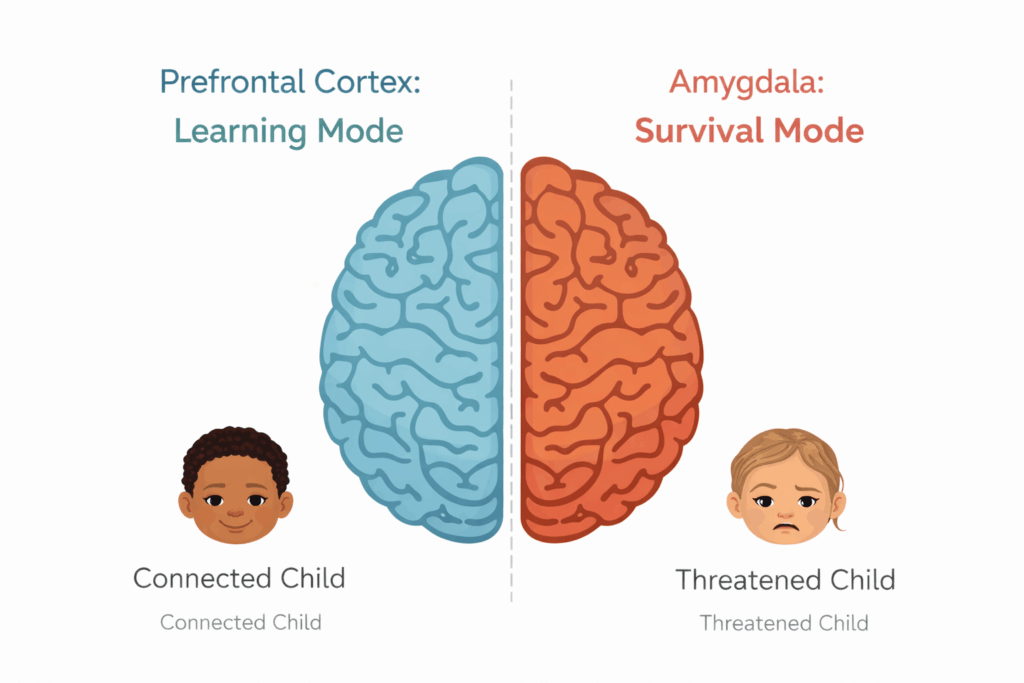
Why does this work? Neuroscience. When a child feels seen, their prefrontal cortex — the reasoning, learning part of the brain — stays online. When they feel threatened or shamed, the amygdala takes over. You literally cannot teach a brain in survival mode. Connection first is not softness. It’s strategy.
My personal version: I say, “I see you’re frustrated right now. And [behavior] isn’t okay. Let’s figure this out.” Three sentences. Ten seconds. And suddenly we’re having a real conversation instead of a power struggle.
This is also directly tied to building emotional intelligence in children — when you model how to name and acknowledge emotions, kids internalize that skill for themselves over time.
Pillar 2: Clear, Non-Negotiable Limits
Here’s where hybrid parenting parts ways with pure gentle parenting. Limits are not suggestions. They’re not opening bids in a negotiation. They’re clear, explained once (in age-appropriate terms), and held consistently. Consistency is the entire game. A boundary that holds 80% of the time teaches your child that 20% effort will eventually crack it.
I learned this the hard way when I gave in on bedtime “just this once” three nights in a row. Spoiler: it stopped being “just this once” very quickly.
I recommend starting with just three non-negotiables: one safety rule, one respect rule, one routine rule. Master those before you expand. Pick the most important things and hold those like a rock.
Pillar 3: Logical and Natural Consequences
Old-school punishment — you hit your sister so no dessert — doesn’t actually teach anything except that adults have arbitrary power. Hybrid parenting uses consequences that are directly and logically connected to the behavior. Kids understand this intuitively. They may not like it, but they accept it as fair in a way they never accept arbitrary punishment.
This aligns directly with what positive discipline teaches: when consequences make sense, they actually teach the lesson instead of just triggering resentment.
| Behavior | Arbitrary Punishment | Hybrid Consequence | What the Child Learns |
|---|---|---|---|
| Leaves bike in the rain | Grounded for a week | No bike for 2 days; helps clean it | Care for your things or lose them |
| Won’t do homework | No dessert | Homework done before any screens | Work before play — always |
| Hits sibling | Sent to room alone | Sits with parent, repairs with sibling | Hurt someone → fix the relationship |
| Breaks toy through misuse | Toy thrown away | Toy away for one week, earned back | Actions have proportional consequences |
| Refuses dinner | Forced to stay at table | No snacks after — hunger is natural | Eating is a choice with real results |
Pillar 4: Age-Appropriate Autonomy
Hybrid parenting gives kids real choices — inside parameters that the parent sets. “What do you want for breakfast?” creates decision fatigue and often spirals into a negotiation. “Scrambled eggs or cereal?” gives genuine choice inside a reasonable frame.
One of the best ways to give toddlers age-appropriate autonomy is through hands-on activities that build real skills. Montessori activities for toddlers are fantastic for this — they’re designed around exactly this principle of giving children real tasks with real outcomes inside a prepared environment.
For school-age kids, the fun activities that secretly teach life skills I’ve covered on this blog are another great way to build autonomy without making it feel like a chore. When kids learn they’re capable, they stop needing to fight for control — because they already have it in the areas that matter.
Pillar 5: Repair Is Always Part of the Plan
This one changed everything for me. You will yell. You will give in when you shouldn’t. You will say something you regret. Hybrid parenting doesn’t demand perfection — it demands repair. Coming back to your child after a hard moment, naming what happened, and reconnecting is not a parenting failure. It is the parenting.
John Gottman’s research is clear: repair — not conflict avoidance — is the actual predictor of healthy long-term relationships. Parents who repair after hard moments are teaching their children something invaluable: how to repair relationships after conflict in their own lives.
The repair script that works: “Hey. I got too loud earlier and that wasn’t okay. I was frustrated, but that’s on me to handle better. I love you and I’m sorry. Can we start over?” That’s it. That’s the whole script. It works at age 4 and age 14.
5. Real-World Hybrid Parenting Examples By Age Group
Theory is great. But parenting doesn’t happen in theory. It happens at 7:15am when everyone’s running late and someone spilled juice on their homework. So let me show you what hybrid parenting actually looks like in the messy, real, non-curated version of family life — organized by age because what works with a 3-year-old looks nothing like what works with a 16-year-old.
Toddlers (Ages 2–4): Where Most Parents Feel the Tension Most
Toddlers are developmentally wired to push limits. That’s normal — they’re figuring out where they end and the world begins. The problem is that pure gentle parenting at this stage often creates what I call the “negotiation trap,” where every limit becomes a 20-minute conversation that the toddler learns to outlast.
Real Scenario: The Bedtime Refusal
What happened: 8pm. Your 3-year-old has had three stories and now wants “just one more.” Crying is starting. Everyone is tired.
| Style | Response | Result |
|---|---|---|
| Permissive | Read another story to stop crying | Tomorrow: four stories minimum |
| Harsh | “No. Stop crying. Bed. Now.” | Child feels abandoned; harder to settle |
| Social-media gentle | Sit on floor, process every feeling, 45 mins pass | Nobody sleeps. Parent burns out. |
| Hybrid | “I loved reading with you. Bedtime is bedtime, buddy. I’ll check on you in 5 minutes.” Hug, leave, return once briefly. | Limit held. Child feels seen. Sleep happens. |
Real Scenario: Supermarket Meltdown Over Candy
Hybrid response: Crouch to eye level. “I know you really wanted that. It does look yummy. We’re not getting it today.” Take their hand, keep moving. Don’t bargain. Don’t explain at length. One sentence, compassionate tone, firm action. The meltdown will escalate briefly, then end. Hold the line. Breathe.
If you’re in the toddler stage and traveling with little ones, check out my guide on toddler travel essentials — a lot of the hybrid parenting principles around structure and predictability apply directly to keeping toddlers regulated on the road too.
And if you’re looking for ways to channel toddler energy productively, these Montessori activities are specifically designed around toddler autonomy and skill-building — perfect alongside the hybrid approach.

School-Age Kids (Ages 5–10): When Explanations Actually Land
This is where hybrid parenting starts to feel easier. Kids this age can handle real reasoning. They understand cause and effect. They have a developing sense of fairness. And when you talk to them like they’re intelligent — which they are — they respond way better than you’d expect.
Real Scenario: The After-School Homework Battle
What happened: Your 7-year-old slams their backpack and says homework is “stupid and too hard.”
Hybrid response:
- Don’t argue about whether it’s stupid. “Sounds like a rough day.”
- Snack first. Hungry kids literally cannot focus — blood sugar is real.
- Sit with them for the first 5 minutes to start momentum. Not doing it for them — just present.
- Step away, check back in when done. Celebrate finishing, not just the grade.
- The rule doesn’t move: Homework before screens. Every day. Without exception.
For this age group, building real-world skills alongside academics makes a huge difference. These activities that secretly teach life skills are great for school-age kids — they build the same competence and internal motivation that hybrid parenting aims for, just in a fun, low-pressure way.
You might also consider supplementing with some STEM toys that build problem-solving skills — for kids who resist traditional homework, hands-on learning tools can build the persistence and frustration tolerance that hybrid parenting is working to develop.
Real Scenario: The Sibling Fight Over a Screen
- Step in calmly. Remove the device. “This is away until we figure it out.”
- Separate both kids for 10 minutes — real calm-down time, not just a pause.
- Bring them together. Each gets 90 seconds to explain without being interrupted.
- Parent asks: “What would be fair here?” — let them propose the solution when possible.
- If physical contact happened: 30-minute shared screen break regardless of who “started it.”
Tweens (Ages 11–14): The Stage That Tests Everything You’ve Built
Tweens are developmentally supposed to start separating from parents. They’re supposed to push back, question everything, and find the limits. That’s healthy. What determines whether this phase destroys your relationship or strengthens it is the foundation you’ve built — and whether you can stay warm while holding your ground.
Real Scenario: “Everyone Has TikTok Except Me”
What happened: Your 11-year-old is furious that you haven’t allowed TikTok. Says it’s “unfair” and “embarrassing.”
Hybrid response:
- Don’t dismiss the social pressure. It’s real. “I get that feels genuinely hard. That’s a real feeling.”
- Explain the reasoning like they’re intelligent: “TikTok’s algorithm is specifically designed to be addictive. That’s not about trust in you — it’s about protecting your brain development.”
- This is also a great moment to revisit the research on screen time vs outdoor play together — share the data with your tween directly. Treating them like someone who can understand research builds exactly the kind of trust and respect that hybrid parenting is after.
- Offer a clear timeline: “At 13, we revisit with specific agreements in place.”
- Hold the limit. Don’t negotiate the limit itself — but absolutely acknowledge their frustration as valid.
The fastest way to lose a tween is to dismiss their social reality. The fastest way to keep their respect is to explain rules like they’re smart — because they are.
Teenagers (Ages 15–18): Your Role Shifts to Consultant
By now, the relationship you’ve built is everything. If you’ve done the connection work, teens will still come to you — even when they push back hard. The limits at this stage become agreements where possible. Natural consequences do a lot of the teaching.
Real Scenario: Missed Curfew Without Contact
- In the moment: Don’t start the conversation furious. “Glad you’re safe. We’re talking tomorrow morning.”
- Next morning: “Walk me through what happened.” Listen fully. Actually listen.
- If there was a legitimate reason: Acknowledge it. It doesn’t erase the consequence but changes the context.
- Consequence: One week of earlier curfew. Logical, proportional, explained clearly.
- Future plan: Agree on a check-in protocol — give them a way to ask for a later time in advance, so they don’t feel trapped by the rule.
Hybrid Parenting By Age: Quick Reference
| Age Group | Focus | Key Hybrid Principles |
|---|---|---|
| 0–2 (Babies) | Secure attachment + routine | Respond to all cries; predictable schedules; cannot spoil a baby |
| 3–5 (Toddlers) | Limits + emotional vocabulary | Bounded choices; one-step instructions; simple logical consequences |
| 6–10 (School-age) | Responsibility + accountability | Kids help create rules; natural consequences; intrinsic motivation |
| 11–14 (Tweens) | Trust + autonomy in low-risk areas | Pick battles; explain reasons; hold firm on non-negotiables |
| 15–18 (Teens) | Launching capable adults | Rules become agreements; natural consequences teach; stay available |
6. Hybrid Parenting Across Cultures: A Perspective Nobody Talks About
Here’s something that genuinely surprised me when I started researching this. The thing we’re calling “hybrid parenting” — warm connection paired with clear structure — is not new. In fact, Western parents are in many ways just now arriving at a framework that huge portions of the world have practiced for generations.
What Non-Western Parenting Traditions Show Us
In many East Asian cultures — Chinese, Korean, Japanese family structures specifically — there’s a long tradition of deep parental warmth and high family involvement alongside very clear expectations, structured routines, and firm limits. The combination is not experienced as contradictory. It’s understood as love.
In Latin American families, the concept of familismo — deep family loyalty, emotional closeness, strong parental authority — reflects the same model. Parents are warm and involved, and unambiguous about values and expectations. These two things coexist naturally, without anyone needing to coin a term for it.
Why This Matters for Multicultural Families
If you’re navigating different cultural expectations about parenting — maybe one partner grew up in a more structured household and the other in a more emotionally expressive one — hybrid parenting gives you a framework for bridging both. You don’t have to choose between honoring your cultural background and incorporating new research. The two are more compatible than most parenting content suggests.
A perspective worth sharing: The very fact that Western parenting is “discovering” hybrid parenting as something new reveals what happened: the gentle parenting movement was a correction to a specific kind of cold, strict Western parenting. That correction was necessary. But the pendulum swung too far. Hybrid parenting is the pendulum finding center — which is where most of the world’s parenting has always been.
7. What the Science Actually Says About Balanced Parenting
Let me nerd out for a second here, because this is important. The science backing the hybrid approach has been building for over 50 years. What’s new is the name. The evidence itself is not new at all — it’s some of the most replicated findings in all of developmental psychology.
Baumrind’s Foundational Research
Diana Baumrind’s work at UC Berkeley starting in the 1960s is the cornerstone. She identified three parenting types: authoritarian (high demand, low warmth), permissive (high warmth, low demand), and authoritative (high warmth, high demand). Her longitudinal research — replicated across different researchers, cultures, and decades — consistently showed that authoritative parenting produced the best outcomes across every metric. Academic performance. Social competence. Emotional regulation. Self-esteem. Resilience. Lower rates of anxiety and depression in adulthood.
Attachment Theory: The Warmth Side of the Equation
John Bowlby and Mary Ainsworth’s work on attachment theory established that secure attachment — built through consistent, responsive caregiving — is the single most powerful predictor of healthy adult psychological functioning. This is where gentle parenting’s emphasis on emotional attunement is fully supported. Children need to feel securely attached to thrive.
What attachment theory does not say is that secure attachment requires the removal of all limits. Research on securely attached children consistently shows that their parents are both responsive AND boundaried. The two go together. They always have.
This is exactly why developing emotional intelligence in children is not in conflict with setting firm limits — in fact, the two reinforce each other. Secure kids can handle limits better. Kids with limits develop better emotional regulation. It’s a cycle, and hybrid parenting is how you start it.
Siegel’s Neuroscience: Why Connection Before Correction Works
Daniel Siegel’s work brought brain science into the parenting conversation profoundly. A connected child operates from their prefrontal cortex — capable of reasoning, learning, and emotional regulation. A shamed or cornered child operates from their amygdala: fight, flight, freeze. You cannot teach anything to a brain in survival mode. Connection first literally prepares the brain to receive the correction.
The Research Summary
| Research | Key Finding | How Hybrid Parenting Uses It |
|---|---|---|
| Baumrind (1966–1991) | Authoritative parents produce best outcomes on every metric | Structure + warmth are both non-negotiable |
| Bowlby & Ainsworth | Secure attachment predicts healthy adult functioning | Emotional connection is built deliberately and daily |
| Siegel (1999–present) | Brain integration requires connection before correction | Validate feelings before addressing behavior — always |
| Gottman | Repair (not conflict avoidance) predicts relationship health | Coming back after hard moments is a built-in expectation |
| Deci & Ryan (SDT) | Autonomy + competence + connection = intrinsic motivation | Age-appropriate choices inside firm limits build internal drive |
8. What a Real Hybrid Parenting Day Actually Looks Like
I want to give you something concrete here. Not an idealized version. An actual realistic sketch of how these principles play out across one ordinary day with a 7-year-old and a 4-year-old. Because the theory only matters if it works at 7am on a Wednesday.
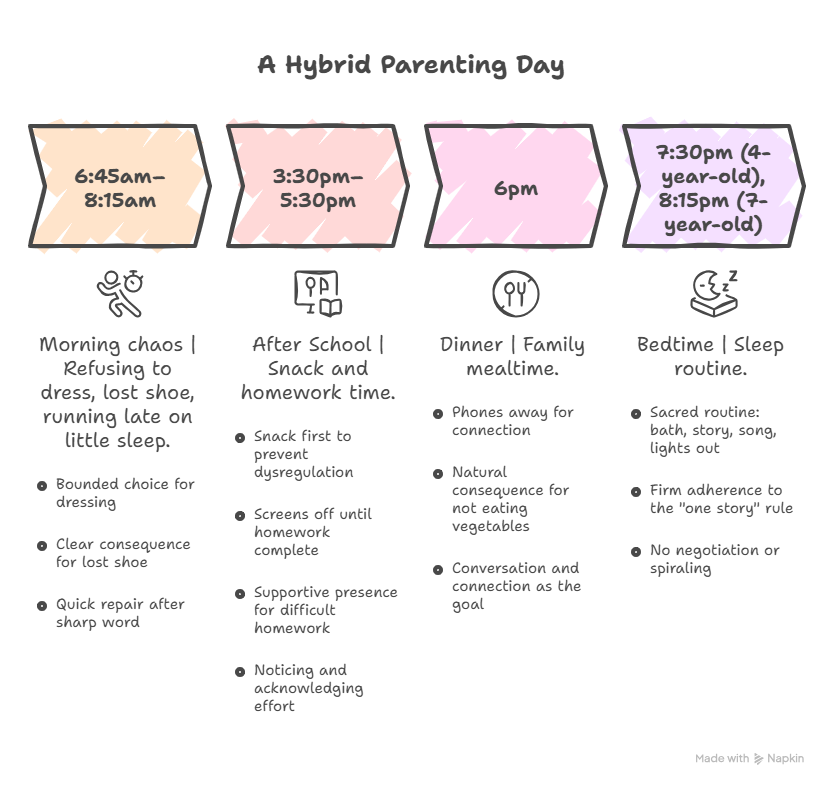
Morning: 6:45am–8:15am
The 4-year-old refused to get dressed. The 7-year-old couldn’t find her other shoe. I was making lunches, running late, and functioning on six hours of sleep.
Hybrid parenting in practice: I gave the 4-year-old two choices: “Red shirt or blue shirt — you pick, we have 2 minutes.” For the shoe situation: “Check by the front door. If it’s not there, you wear the backup pair — we’re not missing the bus.” No drama. Clear consequence. Both kids got out the door. Did I speak sharply once? Yes. Did I repair quickly? Yes. That’s the whole thing.
After School: 3:30pm–5:30pm
Snack first — always. Hungry kids are dysregulated kids. After snack: the homework rule kicks in. Screens are off until homework is complete. This rule has been in place long enough that there’s no longer a fight about it. Consistency made it part of the landscape rather than a daily negotiation.
Dinner: 6pm
Phones away. Everyone at the table. The 4-year-old didn’t want to eat the broccoli. We didn’t force it — but there was no dessert. Natural consequence, low drama, not made into a big deal. Conversation happened. Connection happened. That’s the point of dinner.
Bedtime: 7:30pm (4-year-old), 8:15pm (7-year-old)
Routine is sacred. Bath, story, one song, lights out. The 4-year-old tested it tonight — wanted another story. “One story is the rule. I love you, goodnight.” Returned once to check in as promised. That was it. No negotiation, no spiraling.
Honest note: This is a good night. There are nights where everything falls apart and I end up repairing two things before the kids go to sleep. That’s normal. The point isn’t the perfect execution — it’s the general direction.
9. Hybrid Parenting Mistakes to Avoid (I Made Most of These)
I want to save you the time it took me to figure these out. These are the most common failure points, in order of how badly they’ll derail your progress if you let them slide.
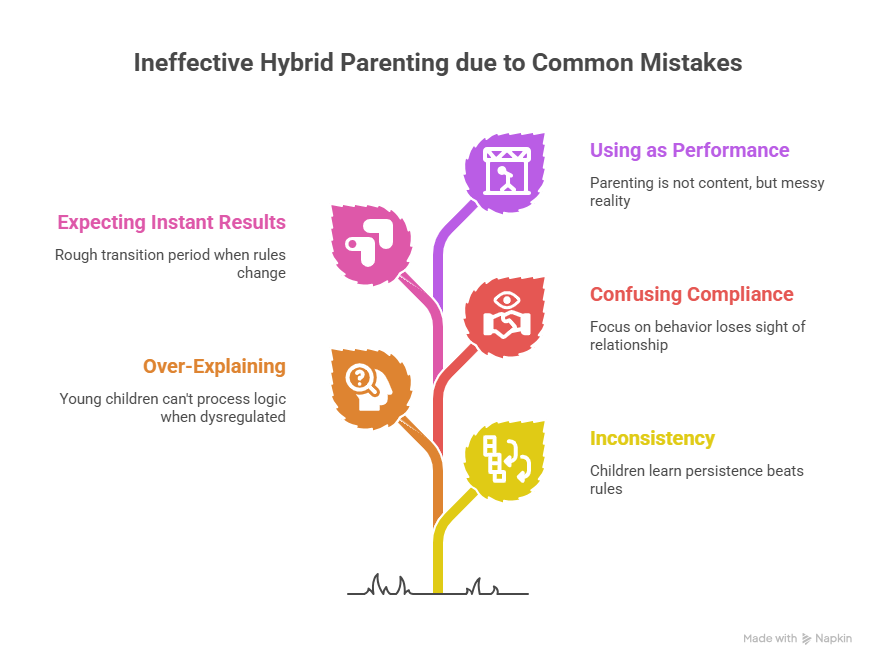
Mistake 1: Inconsistency — The #1 Killer
A boundary that holds 80% of the time teaches children that 20% effort eventually cracks it. Every time you give in because you’re tired or in public or just done, you reset the clock. The child learns that persistence beats the rule. This is not a character flaw in your child — it’s a logical response to the data you’ve been giving them.
The fix: Write down your 3 non-negotiables. Literally write them down and put them somewhere you see them. When you’re tempted to give in, check: is this on the list? If yes, hold it. Everything else can flex. The short list doesn’t.
Mistake 2: Over-Explaining to Young Children
Hybrid parenting does involve explaining reasons for rules. But not to a dysregulated 3-year-old in the middle of a meltdown. Young children cannot process logic when their emotional brain is flooded. Five-paragraph explanations at that moment are noise they literally cannot hear. They feel like lectures, and lectures make meltdowns worse.
The fix: For under-5s: one sentence, warm tone, firm action. “We don’t hit. I’m going to hold your hands.” Save the explanation for 20 minutes later when they’re fully calm. Then it lands.
Mistake 3: Confusing Compliance With Connection
A child who always does what you say isn’t necessarily a securely attached child. Some children comply out of anxiety or fear — not genuine respect. If you’re so focused on behavior that you lose sight of the relationship underneath it, you’ve missed the whole point of hybrid parenting.
The fix: 10 minutes of fully undivided, child-directed play per day. No phone. No agenda. Just following their lead. Research from Stanley Greenspan shows this single habit does more for behavior long-term than any discipline strategy. This is also exactly what positive discipline emphasizes — the relationship is the discipline strategy.
Mistake 4: Expecting Instant Results
If you’ve been inconsistent or permissive for a while, expect a rough transition period when you tighten things up. Kids will test harder when the rules change — they need to know if the new limits are real. This is developmentally normal and is not a sign of failure.
The fix: Commit to 6–8 weeks before evaluating. Keep a simple log — even just a few bullet points weekly. When you feel like quitting around week 3, the log will show you the actual progress and keep you going.
Mistake 5: Using Hybrid Parenting as a Performance
If you’re aware of “executing hybrid parenting correctly” while you’re doing it, something has gone sideways. Real parenting is messy. The goal isn’t to perform a framework — it’s to generally move in the right direction, repair when you don’t, and keep going. Parenting is not content.
The fix: Unfollow the accounts that make you feel graded. Your child doesn’t need a perfect parent. They need a present one. That’s genuinely the whole thing.
10. Best Books, Podcasts, and Tools for Hybrid Parenting
You don’t need 20 books. You need two or three that you actually read and apply. Here are the ones that directly inform the hybrid approach — plus a few tools that make consistency easier in daily life.
Essential Reading List
| Book | Author | Why It Belongs Here | Best For |
|---|---|---|---|
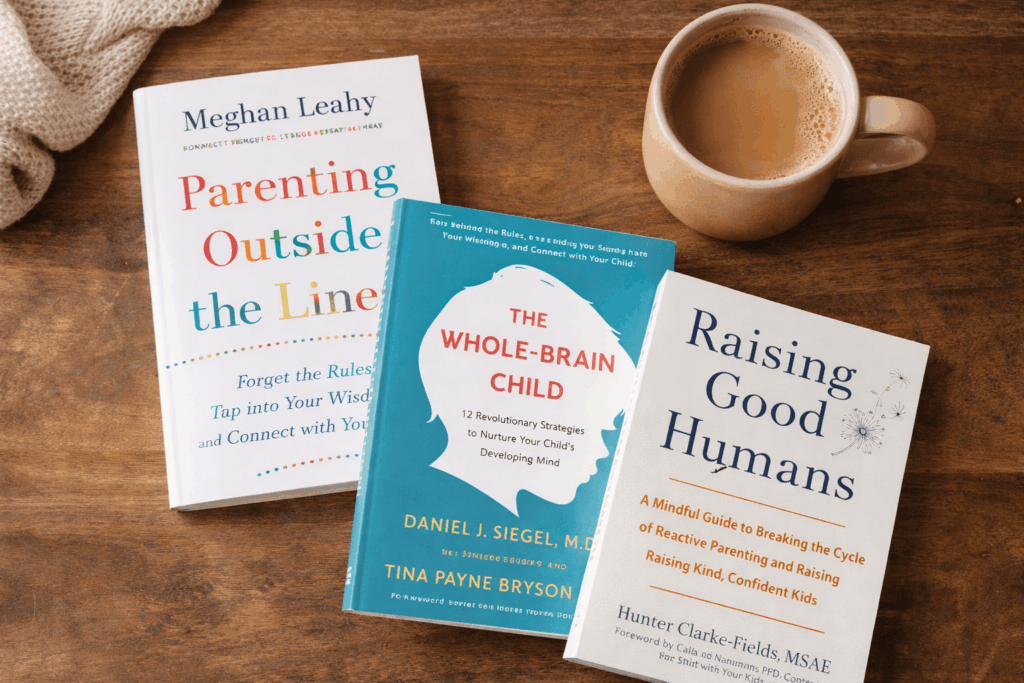
| The Whole-Brain Child | Siegel & Bryson | Neuroscience backbone of hybrid parenting — why connection before correction works | All parents, especially under-12 |
| No-Drama Discipline | Siegel & Bryson | Practical hybrid discipline framework — connect, then redirect | Parents struggling with behavior |
| How to Talk So Kids Will Listen | Faber & Mazlish | Gold standard for respectful, effective communication | Every parent, every stage |
| The Explosive Child | Ross W. Greene | Collaborative problem-solving for strong-willed or sensitive kids | Parents of challenging children |
| Untangled | Lisa Damour | Teen brain development + hybrid approach for adolescent years | Parents of tweens and teens |
| The Blessing of a Skinned Knee | Wendy Mogel | The case for letting kids struggle — essential counterbalance to over-protection | Parents who tend to over-protect |
Podcasts Worth Your Commute
- Good Inside with Dr. Becky Kennedy — The closest thing to hybrid parenting in audio form. Kennedy advocates for seeing children as “good inside” while maintaining firm, loving limits.
- Janet Lansbury: Unruffled — Calm, authoritative, deeply practical. Particularly excellent for the toddler years.
- Big Life Journal Podcast — Growth mindset for kids and parents. An excellent complement to hybrid parenting principles.
- Raising Good Humans with Hunter Clarke-Fields — Mindfulness for parents. Because you cannot regulate your child’s emotions if you haven’t done the work on your own.
Apps That Support Consistency
| App / Tool | What It Does | Hybrid Parenting Use Case |
|---|---|---|
| Cozi Family Organizer | Shared calendar, routines, lists | Building predictable structure that reduces daily conflict |
| ChoreMonster | Chore tracking with reward system | Age-appropriate responsibility + motivation kids actually care about |
| Calm / Headspace | Mindfulness and stress reduction | Your emotional regulation comes before your child’s — manage yours first |
| OurFamilyWizard | Co-parenting communication platform | Consistent rules and tone across two homes |
| Goally | Visual routine and task management for kids | Independence-building through visual routines — less nagging, more self-direction |
If you’re also looking for the best physical gear to support structure and routine with a new baby, check out the complete baby products buying guide and the 5 must-have baby gears that save you 10+ hours a week — building a consistent environment starts with having the right tools from day one.
Frequently Asked Questions About Hybrid Parenting
Conclusion: The Most Honest Parenting Approach of 2026
Here’s what I want you to hold onto from everything in this guide. Hybrid parenting isn’t a promise that your kids will behave perfectly, that tantrums will stop, or that the homework battle will disappear. It won’t. Kids are kids.
What hybrid parenting offers is something more valuable than perfect behavior: a framework that actually holds up in real life. Not just on the good days — on the hard Tuesday mornings when everything’s going sideways and you’re running on too little sleep and someone just spilled cereal on the carpet.
The research has always pointed here. Warm and firm. Connected and clear. Understanding and consistent. Your child needs your empathy — genuinely, deeply. And they also need the security of knowing where the edges are. Both things are true. Both things are love.
Here’s where to start, practically:
- Week 1: Write down your 3 non-negotiables. Nothing else changes yet.
- Week 2–4: Practice connection before correction in those specific situations. Notice the difference.
- Week 5–6: Add one logical consequence framework to your most recurring conflict area.
- Ongoing: Repair after hard moments. Every time. That’s the whole thing.
You don’t have to get this perfect. You just have to keep going. And — this part really matters — you already have everything you need to do this well.
And if you’re building this out from the ground up with a new baby, start with a strong foundation — check out my guides on the best baby products for new parents and what to really expect during postpartum recovery — because hybrid parenting starts with a parent who’s supported, rested, and resourced.
Are you already doing some version of hybrid parenting without having a name for it? Or are you just starting to make the shift? Drop your experience in the comments — what’s working, what’s hard, what questions are still rattling around. The best parenting advice in any comment section usually comes from parents who are actually in it. Let’s figure this out together. 👇