
How to Handle Toddler Tantrums: 10 Proven Strategies That Actually Work in 2026

🔑 Quick Answer: How to Handle Toddler Tantrums?
To handle toddler tantrums, stay calm, ensure your child is safe, and validate their feelings without giving in to demands. The most effective strategies include identifying triggers beforehand, using the “time-in” method, offering limited choices, and teaching simple self-regulation skills. Tantrums peak between ages 2 and 3 and are a normal part of brain development.
Your toddler is flat on the supermarket floor, screaming like the world is ending, because you said no to a chocolate biscuit. You can feel every eye in the aisle on you. Your face is hot. Your brain is blank. And somewhere in the back of your mind, a small voice whispers: “Am I doing something wrong?” You are not. Tantrums occur in 91% of children between 30 and 36 months old, which means almost every parent standing in that supermarket has been exactly where you are.
In this guide, you will get 10 research-backed, expert-approved strategies for how to handle toddler tantrums — in public, at home, and in every exhausting in-between moment.
KEY TAKEAWAYS:
1. Toddler tantrums are developmentally normal and peak between ages 2 and 3 — they are not a sign of bad parenting.
2. The most effective in-the-moment response is staying calm, ensuring safety, and validating feelings without giving in to demands.
3. Identifying your child’s specific triggers is the single most powerful prevention tool.
4. Giving toddlers limited choices throughout the day reduces the frequency of tantrums significantly.
5. The conversation after a tantrum, once your child is calm, is where the real emotional learning happens.
6. Tantrums lasting more than 15 minutes consistently, or occurring more than 5 times per day, may warrant a conversation with a pediatrician.
Why Toddlers Have Tantrums: What’s Actually Happening in Their Brain
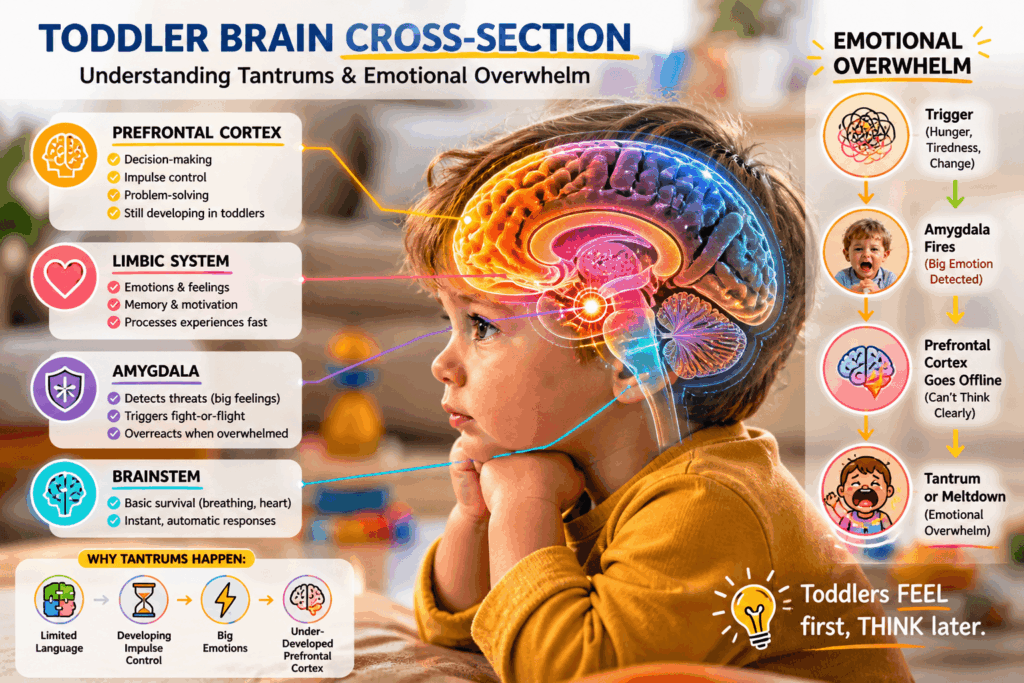
Toddler tantrums happen because the part of the brain responsible for emotional regulation — the prefrontal cortex — is still developing. Toddlers experience intense emotions but do not yet have the neurological ability to manage them. The tantrum is not disobedience. It is a brain that has been overwhelmed and has no other way to cope.
Tantrums are a sign that your child’s brain is still under construction. In the toddler and preschool years, the part of the brain responsible for emotional regulation — the prefrontal cortex — is still developing. That means children are driven by big feelings they can’t yet manage, and they rely on adults to help them co-regulate.
This is the reframe that changes everything for most parents. Your toddler is not trying to manipulate you. They are not testing you on purpose. They are genuinely overwhelmed by an emotion that is too big for their current wiring to process.
When a toddler’s desire to do something doesn’t align with their ability, frustration is often the result. To further compound things, toddlers typically don’t have the language skills to ask for help if things don’t go smoothly. This combination of big feelings, limited language, and an underdeveloped regulatory brain is precisely what produces a tantrum.
Tantrums occur once a day, on average, with a median duration of 3 minutes in 18- to 60-month-old children. Tantrums most commonly occur between the ages of 2 and 3. Researchers have found that tantrums occur in 87% of 18- to 24-month-olds, 91% of 30- to 36-month-olds, and 59% of 42- to 48-month-olds.
“Tantrums are not a sign of disobedience — they are a sign of dysregulation, which means the inability to manage emotional responses.” — Good Inside, Dr. Becky Kennedy’s parenting platform (October 2025)
The severity, frequency, and length of tantrums naturally decrease as children get older and their prefrontal cortex matures. This stage will end. Understanding why it is happening right now makes it significantly easier to respond with the calm your child actually needs from you.
Understanding how toddler tantrums connect to bigger emotional development is worth exploring in depth. Our guide on emotional intelligence in children explains exactly what skills are forming during these early years — and why they matter more than IQ.
The next section gives you a clear, step-by-step response method you can use in any tantrum situation — home, public, or anywhere in between.
How to Respond During a Tantrum: The 4-Step Method
When a tantrum starts, follow these four steps in order: ensure safety, stay calm yourself, validate your child’s feelings with a short phrase, and wait without giving in or withdrawing completely. This approach stops you from escalating the situation while teaching your child that emotions are safe to feel.
Devon Kuntzman, PCC, parenting coach and founder of Transforming Toddlerhood, outlines this approach clearly in her CNBC interview (January 2026).
Here are the four steps:
Step 1: Ensure safety first. If your child starts to melt down in public, make sure both you and your child are in a safe environment for them to do so. At the grocery store, for example, you might go into a quieter aisle or a bathroom. At home, move them away from anything they could hurt themselves on. This is the only active physical step during the tantrum.
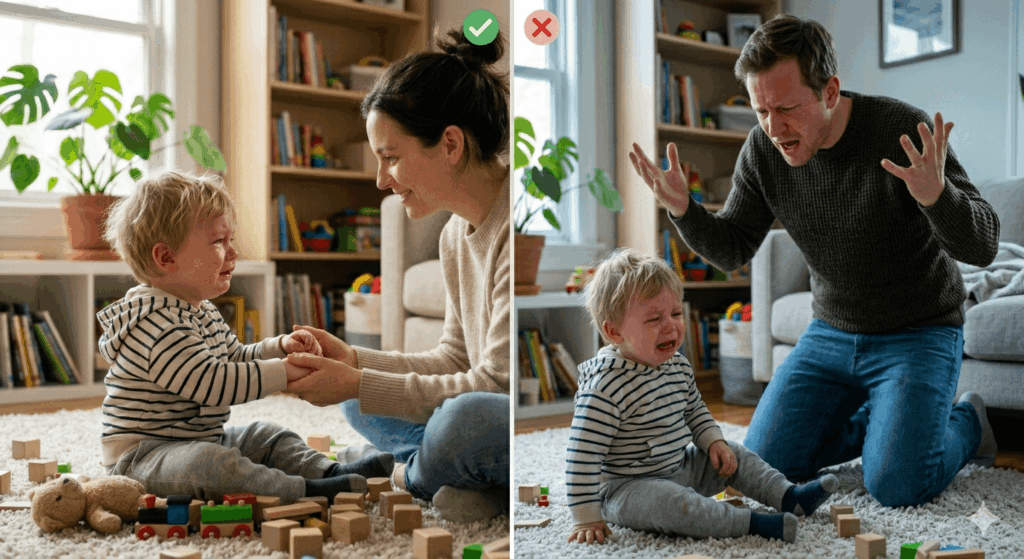
Step 2: Stay calm. Seriously. Typically, the best way to respond to a tantrum is to stay calm. If you respond with loud, angry outbursts, your child might copy your behavior. Shouting at a child to calm down is likely to make things worse. Take a slow breath before you say anything. Your nervous system communicates directly to theirs.
Step 3: Validate without giving in. Use a short, clear validation phrase: “I can see you’re really upset.” or “I know you really wanted that.” This is not the same as agreeing with the demand. You are acknowledging the emotion, not the behavior. Validation lowers the brain’s threat response. Once a child feels understood, their nervous system begins to settle — and the tantrum ends naturally, without punishment or bribes.
Step 4: Wait and stay present. When your child is mid-tantrum, they’re not in a state to learn or listen. The goal isn’t to stop the tantrum straight away, but to stay calm and support your child through it. Sit nearby. Do not lecture. Do not negotiate. Do not physically restrain unless safety requires it. Let the wave pass.
These four steps work because they address what is actually happening in your child’s brain — not what you wish were happening.

Knowing how to respond in the moment is only half the work. Understanding what triggered the tantrum in the first place is what actually reduces how often they happen.
How to Identify and Manage Tantrum Triggers
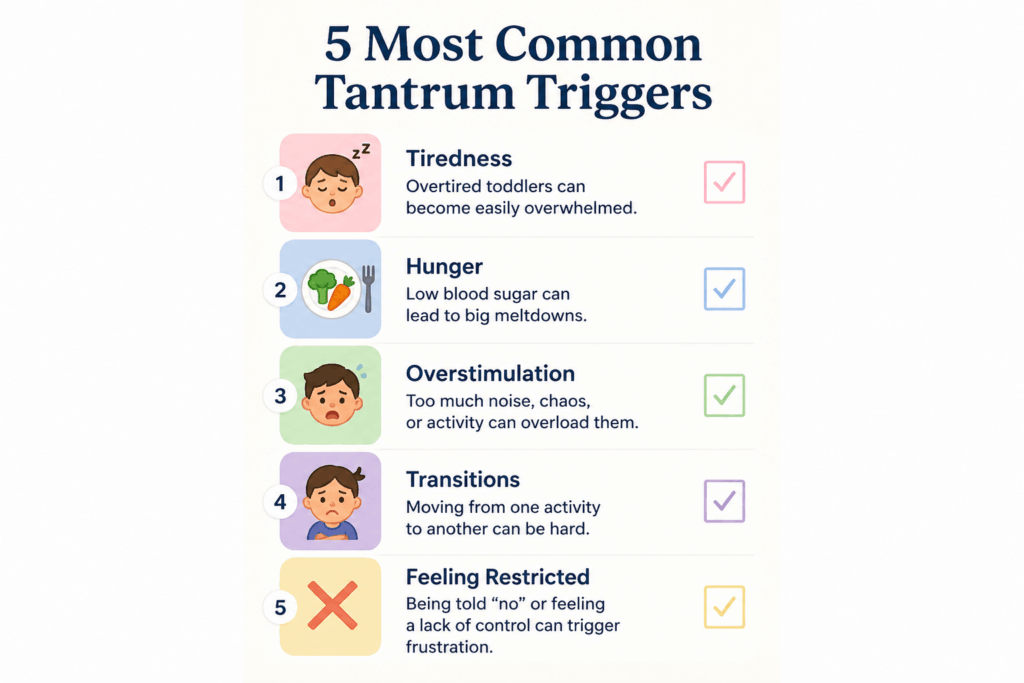
Most toddler tantrums have predictable triggers, including hunger, fatigue, overstimulation, transitions, and unmet desires for independence. Identifying your child’s personal pattern is the single most effective prevention strategy available to parents, because you can plan around triggers before they ignite.
Tantrums are typically triggered by specific situations, so identifying these patterns helps parents develop prevention strategies. Mental health professionals call this a “functional assessment”: looking at what happens immediately before, during, and after an outburst to find the recurring pattern.
The most common tantrum triggers, according to child development research, include:
- Hunger and fatigue. These are the most reliable and most preventable triggers. A tired, hungry toddler has a dramatically reduced frustration tolerance.
- Transitions. Moving from a preferred activity (playing) to a non-preferred one (leaving the park, getting dressed) is one of the top tantrum triggers across all age groups.
- Sensory overload. Sensory overload significantly contributes to toddler meltdowns. When a child is adjusting to new people, thrown off of their usual schedule, or otherwise overwhelmed, their frustration tolerance is understandably lower.
- Desire for independence. Toddlers are developmentally wired to want to do things themselves. When they are stopped, redirected, or fail at a task, the frustration can be immediate and intense.
- Unmet physical needs. Any combination of hunger, thirst, illness, or discomfort lowers the threshold for an emotional outburst significantly.
To find your child’s specific pattern, keep a simple three-day log: write down the time of each tantrum, what happened just before it, and what resolved it. Most parents spot a clear pattern within two or three days.
Screen time and overstimulation are increasingly recognized as tantrum triggers in 2026. Our deep-dive into screen time vs outdoor play covers the research on what overstimulation does to toddler behavior and what the data says about managing it.
Triggers handled. Now for the scenario that makes most parents sweat: the public tantrum.
How to Handle Public Tantrums Without Losing Your Mind
Public tantrums feel worse than they are because of the perceived judgment of strangers. The response strategy is identical to at-home tantrums: ensure safety, stay calm, validate, and wait. The key addition for public situations is managing your own embarrassment so it does not escalate the situation further.
Don’t take it personally. Remember that your child’s tantrum isn’t a reflection of you as a person or of your parenting. Shift your perspective. Instead of thinking your toddler is trying to cause a scene, understand that they’re really just having a hard time coping.
That reframe is genuinely useful. The strangers in the aisle are not judging you as harshly as your anxiety suggests. And the ones who are parents? They are almost certainly thinking: “Been there.”
Practical steps for public tantrums:
- Move to a quieter space if possible — a less busy aisle, outside, or near the entrance.
- Get down to your child’s level. Crouching or sitting removes the physical power dynamic that can escalate things.
- Use a low, slow voice — not a sharp or urgent one.
- If a public tantrum feels too overwhelming, it’s perfectly fine to step away to a quiet space, allowing your child to work through their emotions while giving yourself a moment to ground. This might mean abandoning your cart at customer service or in the aisle and stepping outside or going to the car to calm down.
- Avoid looking at other shoppers. Your attention belongs to your child, not the audience.
Bottom line: you cannot manage your child’s nervous system while your own is in panic mode. Calm yourself first, even if it takes 10 seconds of deliberate breathing.
Manage onlookers with objectivity and compassion. A simple “I’m doing my best” can go a long way. Say it to yourself. Say it out loud if it helps. It is the truth.

Public tantrums are reactive. Prevention is proactive. Here is exactly how to reduce how many tantrums happen in the first place.
How to Prevent Tantrums Before They Start
You cannot eliminate tantrums entirely, but you can significantly reduce their frequency by building predictable routines, offering limited choices throughout the day, giving transition warnings, and noticing early warning signs before the meltdown escalates. Prevention works best when it addresses your child’s specific trigger pattern.
There might be no sure way to prevent tantrums. But there’s plenty you can do to foster good behavior even in the youngest children. These are the strategies with the strongest evidence:
Build a predictable routine. Predictable days help kids feel secure. Build routines. Give warnings for transitions: “Five more minutes of play, then we’re tidying up.” Toddlers cannot yet conceptualize time, but five-minute warnings give them a mental bridge between what they are doing and what comes next.
Offer limited choices. Try to give toddlers some control over little things. Offer minor choices such as “Do you want orange juice or apple juice?” or “Do you want to brush your teeth before or after taking a bath?” This works because many tantrums are triggered by a loss of autonomy. Offering two parent-approved options gives your child a real sense of control without you losing yours.
Protect sleep and mealtimes fiercely. Follow a daily routine with sleeping and eating. This helps ensure your child gets enough sleep and food for the child’s age. A well-rested, well-fed toddler has measurably better frustration tolerance than a tired or hungry one.
Notice early warning signs. Notice early warning signs. If your child is tired or overstimulated, adjust your plans. Whining, clinging, and repeated small refusals are often the pre-tantrum signal. Catch it there and you can redirect before the full storm hits.
Praise positive behavior specifically. Get in the habit of catching your child being good. Reward your little one with praise and attention for positive behavior. Be specific about praising behaviors you want to see happen more often, such as “I like the way you said please and waited for your milk.”
Activities that build self-regulation and emotional skills early also serve as a longer-term prevention strategy. Our article on 10 fun activities that secretly teach your kids life skills has practical, age-appropriate ideas that build the emotional toolkit toddlers need.

Prevention sets the conditions. But the words you use in and around a tantrum matter enormously too.
What to Say During and After a Tantrum
During a tantrum, keep words minimal and warm: short validation phrases like “I see you’re upset” work better than explanations or negotiations. After the tantrum, when your child is fully calm, a brief, simple conversation about what happened builds emotional vocabulary and prevents repeat behavior.
During the tantrum: less is more. When your child’s body is in full distress, every word you add is like oxygen to a fire. Their “thinking brain” has shut down. Words simply can’t land.
Stick to very short phrases:
- “I’m here.”
- “I can see you’re really upset.”
- “It’s okay to feel mad.”
- “I won’t let you hit, but I’m staying right here.”
These phrases do two things simultaneously: they signal emotional safety and they model the vocabulary your child will eventually use to express their own feelings.
After the tantrum: timing is everything. The conversation after a tantrum is where real learning happens, but timing is crucial. Wait until your child is fully regulated — not just done crying, but actually calm and connected again.
When that moment comes, keep it simple and curious:
- “You were really upset before. Do you want to tell me what happened?”
- “I noticed you were angry when we had to leave the park. That’s a really hard feeling.”
- “Next time you feel that way, what could we do instead of screaming?”
According to Raising Children Network (Australia), talking about emotions after a tantrum — when the child is calm — builds emotional vocabulary and self-awareness over time. It teaches children that their feelings are valid and that there are other ways to communicate them.
Praise recovery, not the tantrum. “You were upset, but you calmed down with your breathing. That’s great!” This specific praise reinforces the skill of self-regulation, not just the behavior of being quiet.

Knowing what TO say helps. Knowing what NOT to do is equally important and often overlooked.
What NOT to Do During a Toddler Tantrum
Answer: The most common parenting mistakes during tantrums are giving in to the demand, matching the child’s emotional intensity with anger, over-explaining or lecturing mid-meltdown, and using physical restraint unnecessarily. These responses either reinforce the tantrum behavior or escalate it further.
Do not give in to stop the tantrum. For older children, tantrums might be learned behavior. If you reward tantrums with something your child wants, the tantrums are likely to continue. Giving in once teaches your child that a big enough meltdown will eventually work. Consistency here is genuinely important.
Do not match their energy. When you match their intensity with anger or frustration, you’re asking a dysregulated child to regulate an adult, which is impossible and unfair. Your child’s nervous system reads yours. A loud, frustrated parent tells a dysregulated toddler that the situation really is as dangerous as their brain thought.
Do not lecture mid-tantrum. The prefrontal cortex — the part of the brain that processes language, logic, and reasoning — is effectively offline during a full tantrum. A three-minute lecture at peak emotional intensity is not heard, not processed, and not remembered. Save the learning conversation for after.
Do not use unnecessary physical restraint. If a child is hitting you, you might have an impulse to hold their hands, but that can sometimes feel restricting and lead to greater upset. One way to help them establish a clearer sense of personal space is by sitting with them but placing a cushion or a bag between you.
Do not ignore completely in unsafe situations. The goal is to ignore the behavior and withdraw all attention, so the child learns that tantrums won’t get them what they want. However, ignoring is only appropriate when your child is safe and the tantrum is not posing a physical risk to themselves or others.
The rule is simple: ignore the demand, never ignore the child.
Responding correctly in the moment is one layer. Building the actual skill of emotional regulation in your child is the layer that makes everything else easier long-term.
How to Teach Toddlers Emotional Regulation Skills
Emotional regulation skills are built between tantrums, not during them. The most effective tools include teaching simple feeling words from an early age, modeling calm stress responses out loud, practicing slow breathing as a game, and consistently praising moments when your child manages a difficult feeling well.
Emotional regulation is a skill, not a personality trait. It is learned. And it is built in the thousands of small, calm moments between meltdowns.
Help your child understand their emotions. You can do this from birth by using words to label emotions like “happy,” “sad,” “cross,” “tired,” “hungry,” and “comfy.” The more emotional vocabulary a child has, the less they need their body to communicate for them.
Model regulation out loud. Model positive reactions to stress. For example, “I’m worried this traffic is making us late. If I take deep breaths, it will help me stay calm.” Children learn regulation by watching adults regulate. Narrating your own process is one of the most powerful teaching tools available.
Practice breathing as a game. Teach your toddler a simple breathing technique during a calm, playful moment — not during a tantrum. “Let’s pretend we’re blowing out birthday candles” or “Smell the flowers, blow out the candles” are classics for a reason. Praise positive behaviors and teach self-soothing techniques like slow breathing, counting, and mindfulness to help children manage emotions.
Use feelings charts and visual tools. Offering facial depictions of feelings — such as a sad face, angry face, and happy face — allows toddlers to select the picture that best describes their feelings. This bridges the gap between the emotion they are feeling and the language they do not yet have.
The skills that help a toddler manage a tantrum today are the same skills that build emotional intelligence for life. Our deep-dive into emotional intelligence in children shows exactly why these early years are the most critical window for emotional skill-building.
The style of parenting you bring to these moments also matters. Different approaches handle emotional regulation very differently. If you are navigating what works for your family, our guide on what hybrid parenting actually looks like in practice offers a practical framework for combining gentle connection with clear limits.
And if you want to reinforce these emotional skills through daily play, the positive discipline approach covers how structure and warmth together produce children who are both emotionally secure and well-behaved.
Image Suggestion: Parent and toddler practicing “belly breathing” together on a rug, both cross-legged, hands on stomachs, looking playful and engaged.
Emotional skills built. Now let’s clarify something that trips up many parents: the difference between a tantrum and a meltdown.
Tantrum vs Meltdown: What Is the Difference?
A tantrum is usually goal-oriented — the child wants something or wants to avoid something and uses emotional behavior to achieve it. A meltdown is an involuntary loss of control due to sensory or emotional overwhelm, with no particular goal. The distinction matters because the correct response is slightly different for each.
A “tantrum” is typically goal-oriented — wanting a toy, avoiding bedtime — and may involve an audience. A “meltdown,” particularly common in children with sensory processing differences, is often an involuntary loss of control due to sensory or emotional overwhelm, with no particular goal other than to escape the overwhelming stimulus. Meltdowns tend to be more intense and harder to interrupt with logic or distraction.
In practice, here is how to tell them apart:
Tantrum signals:
- The behavior shifts when the child senses an audience
- The child checks to see if you are watching
- The behavior stops when they get what they want
- The child can be redirected or distracted mid-outburst
Meltdown signals:
- The child cannot be distracted or redirected
- The behavior seems beyond their own control
- There is no obvious external goal or demand being made
- Recovery takes significantly longer than a typical tantrum
The response difference is important. For a tantrum, ignoring the behavior while staying present is appropriate. For a meltdown, the child needs more active co-regulation support — calm presence, reduced sensory input, and physical comfort if they welcome it.
| Feature | Tantrum | Meltdown |
|---|---|---|
| Trigger | Wanting/avoiding something | Sensory/emotional overwhelm |
| Goal | To get something or stop something | To escape the overwhelming stimulus |
| Audience awareness | Often yes | Usually no |
| Distractible | Yes, sometimes | Rarely |
| Recovery time | Usually shorter | Often longer |
| Best response | Ignore demand, stay present | Active co-regulation, reduce stimulation |
Most tantrums are completely normal. But there are specific signs that suggest it is worth a conversation with a professional.
When Should You Worry About Your Toddler’s Tantrums?
Most toddler tantrums are developmentally normal and self-resolve as children develop language and emotional regulation skills. However, tantrums that last more than 15 minutes consistently, occur more than 5 times per day, involve repeated self-harm, or continue regularly beyond age 5 warrant a pediatrician or child psychologist consultation.
It is atypical for children older than 5 years to have a repeated pattern of tantrums. It is also unusual for a tantrum to last more than 15 minutes or to occur more than 5 times per day. Extreme aggression is not typical.
Signs that suggest it is time to seek professional guidance include:
- Tantrums lasting consistently more than 15 to 20 minutes per episode
- More than 5 tantrums per day across multiple days
- Self-harm or harm to others: if your child regularly engages in self-injurious behaviors like head-banging or biting themselves, or consistently tries to hurt others during a tantrum
- Lack of recovery: a child who remains agitated or withdrawn for a long time after the tantrum has passed
- Regular intense tantrums continuing beyond age 5
Sometimes a close look at the pattern of a child’s tantrums reveals a problem that needs attention: a traumatic experience, social anxiety, ADHD, or a learning disorder. When children are prone to meltdowns beyond the age in which they are typical, it’s often a symptom of distress that they are struggling to manage.
Trust your instincts as a parent. If something about your child’s tantrums feels different or disproportionate, a conversation with your pediatrician is always the right move. Early support is far more effective than waiting.

Tantrum Response Strategies Compared: Quick Reference Table
| Strategy | Best Used When | What It Does | Difficulty |
|---|---|---|---|
| Stay calm and validate | During every tantrum | Regulates child’s nervous system via co-regulation | Medium (requires self-control) |
| Ignore the demand | Attention-seeking or goal-oriented tantrums | Teaches that tantrums do not work | Medium |
| Remove from the environment | Overstimulation or public tantrums | Reduces sensory input, removes audience | Easy |
| Offer limited choices | Prevention before triggers hit | Reduces autonomy-related tantrums | Easy |
| Transition warnings | Before any change in activity | Reduces transition-triggered tantrums | Easy |
| Consistent daily routine | As a baseline prevention tool | Reduces fatigue and hunger triggers | Medium |
| Post-tantrum conversation | After full calm has returned | Builds emotional vocabulary and learning | Medium |
| Breathing and regulation practice | Between tantrums, as play | Builds self-regulation skills over time | Easy |
| Praise recovery | After the child calms down | Reinforces the calm behavior specifically | Easy |
| Seek professional support | When red flag signs are present | Rules out underlying developmental concerns | n/a |
Frequently Asked Questions
Conclusion
Toddler tantrums are not a parenting failure. They are a developmental milestone — a signal that your child’s brain is working exactly as it should at this stage, feelings first and regulation second.
The 10 strategies in this guide give you a complete toolkit: understanding the brain science behind how to handle toddler tantrums, responding calmly in the moment, identifying and managing triggers, navigating the public meltdown, building emotional vocabulary, and knowing when to ask for professional support.
Start with the four-step response method this week. Stay calm, validate the feeling, ignore the demand, and wait. That single shift — moving from reactive to intentional — changes the experience of tantrums for both you and your child.
This stage will pass. And the way you show up during it — consistent, calm, and connected — is teaching your child something they will carry for the rest of their life.